The scent of adventure and the thrill of exploring new territory added spice to our 7 a.m. departure one May Sunday in 1999. It was hot and dry and just before the rainy season. Our spirits were high. We had been anticipating this overnight hiking trip into the mountains of northern Oaxaca for the past six months.
I attuned my nose to the smell of the freshly made tortillas that a father and son were selling at a stand on the sidewalk just below the steps where I waited for Octavio. The aroma was tempting on an empty stomach. I had left the bed and breakfast too early for breakfast.
Behind me the bells of Nuestra Senora de Soledad announced mass, and a line of women trudged past me up the steps leading to the church. The elderly and infirm brought up the rear, steadying themselves against the wall beside the stairs.
Octavio arrived, and I climbed into his van. Within a few minutes, we had reached the outskirts of the City where we stopped at a Pemex gas station. Octavio filled two red plastic containers with gas. “Ten gallons for safety,” he announced. “This will be the last gas station. There will be no gas where we are going unless it's sold privately. I don't trust private supplies. They might be diluted.”
We headed north, all the while maintaining a harmonious silence; we and Oaxaca were waking up together. We stopped at the sanitorios beside the turnpike, the last chance to use a real bathroom before we arrived at our destination. Any future roadside bathroom would be located behind a large boulder, a tall thick cactus or a sheltering tree.
We continued north and turned northeast. We stocked up at an outdoor market: toilet paper, a sun hat, bottled water, beer, bread, cheese, a bag of bananas, a bag of mangoes and a can of motor oil. Then we were on our way into the unknown.
In no time, we were high in the mountains following a winding dirt road that kept to the edge of steep cliffs. To one of the vultures slowly soaring overhead in the updrafts, the road would appear as an undulating dragon snaking over and around the mountains. No white roadside crosses marked the scene of fatal accidents in that remote area. Traffic was non-existent. We never did meet another vehicle.
It was noon by the hands of our synchronized watches when we pulled into the village. Israel, the local guide, was waiting. He would accompany us on our hikes through the communally owned land. He waved and gave us thumbs up. We were on time.
We selected three beers from our provisions and presented one to Israel. We ate fruit, bread and cheese while we discussed the details of the hike. I sprinkled the last few drops of my beer on the ground. Turning to face the tallest of the encroaching mountains, I silently petitioned that its spirit would grant us safe passage.
Octavio was amazed. “What are you doing?"
“Appeasing the gods.”
“The Mixes to the south do that; they don't here.”
"Never mind. The ritual is important to me.”
Off we went, well-fed and well-hydrated, following a river until we detoured to the left to labor up a steep foot path. We were headed for a barely visible overhang. Below us, the water sparkled with diamonds as it flowed over and among stones bleached white by the burning sun.
Under the overhang, an opening led to a small cave. Not enjoying close, dark quarters, I sent Octavio and Israel into the cave and settled myself in the lap of a ledge carved by the elements into an armchair. I leaned back against the warm rock and closed my eyes. The sound of the speeding water seemed far away. How high we had climbed in such a short time!
Octavio reappeared, abruptly interrupting my reverie. His face was drained of color. It took him a few minutes to regain his composure. After several deep breaths, he reported, “It was dark, and there were bats. I saw smoke rising from the floor. I got scared and ran out." Israel hadn't seen the smoke, but he believed Octavio’s story. We decided it was energy being released from the earth.
We left the cave's entrance and picked our way back down the trail, slipping and sliding the last few yards. We followed the river into a canyon and then through a succession of canyons fortified by towering cliffs. Vertical walls soared to the sky. Gray-green mosses and lichens created frescoes of impressionistic pictures of deer, dogs and celestial bodies. The landscape was magnificent.
Octavio and I never could identify just when our mood changed. Talking about it was a relief, because we were feeling increasingly angry and depressed for no reason whatsoever. There seemed to be no logical explanation for our irritation and impatience.
Walking was difficult. My feet refused to obey me. I was unable to lift them more than an inch above the ground. They felt as if heavy weights were attached to their soles. Or as if they had grown massive roots, which were anchored deep within the earth. In order to begin a step, I had to uproot one foot and counteract whatever force seemed to be pulling it back down.
We moved through a seemingly endless series of canyons. Hidden springs birthed tumbling brooks that fed the river cutting the canyons’ floor. Small caverns beckoned to be explored. In the distance, a goatherd and his goats stood immobile, as if bewitched.
A constant breeze had been at our backs since we began the hike. The canyons narrowed. Their diminishing width compressed the breeze into a funnel of strong wind. Its hot, incessant breath fueled our edginess. Our mood soured. I clutched my hat. The wind blew it off. I snatched it back. The wind won, and the hat sailed up to an inaccessible ledge.
There were no vultures in the sky, no insects buzzing, no birds singing, no butterflies. The only sign of wild life was a gray squirrel. Israel saw it first. He dove towards it with outstretched hands. He caught it, and for a second, man and squirrel were splayed against the face of the rock. Hunter and hunted froze into a long, continuous line until the squirrel shot up and out of Israel’s grasp and disappeared over the top of a cliff.
A circle of stones, each the size and shape of a cantaloupe, was in front of us. “Look, Octavio. Here is a sacred circle. You and Israel go on. I will wait inside the circle. I will be safe here." The men disappeared. I stepped into the circle and sat on the flat ground. I closed my eyes. Vivid scarlet swirls swam behind them, then erupted into the colors of the rainbow, a kaleidoscope of color and form.
After we regrouped and began the trek back, my feet developed an unanticipated independence. They refused to go in the direction I intended. When I tried to go straight ahead, they veered 45 degrees to the right. After several yards, they effortlessly carried me 45 degrees to the left. Meanwhile, the distance among the men and me lengthened. They stopped and waited for me to catch up. The only thing to do was to surrender to the experience.
It wasn't until we entered the village that our emotions turned positive. It was as if two parallel worlds existed side by side, and we had stepped from one world to its opposite. The world we had left fostered negativity and darkness; the village, with its fertile land and abundant life, fostered tranquility and light. To be an integral part of Nature’s polarity was, for us, a living reality. Our task would be to unify its two aspects.
That evening we wandered through the village, scuffing our shoes in the dirt. The sun had set behind the mountains, and the village was quiet except for the sound of the river, which ran through the lush valley.
Later, I stared up into a night sky spangled with bright stars. They looked as close as the fluorescent stars and planets that once had glowed on my nursery ceiling. Just as when I was a child, they blanketed me with comfort and reassurance. The peacefulness of the night lulled me to sleep and put to rest the day’s tumultuous events.
If Octavio had not dreamt that three witches tried to steal his soul and carry him out the window, we might not have gone for a cleaning. His dream, however, clinched it. Frantic knocks on my door early in the morning attested to the impact the dream had on him. His face was pale. He had awakened with his limbs contorted and his face twisted to one side. I was stunned when he demonstrated the position of his body.
“I protected myself. I made crosses on my back and front. They didn't get me. I fought them off. Are there witches living nearby?”
“No, no witches live nearby,” a villager informed us. “Only a curandera in a distant village. She does limpias (cleanings).”
Israel had scheduled us for a morning hike along a trail rated difficult. I stayed in the village and joined the early risers on their way to the fields. After waving good-by to Israel and Octavio, I wandered along the footpath that bordered the bank of the river. I stepped aside into the tall grass to let a father and son drive a herd of cows to pasture. The path was well worn. Men, as well as animals, had traveled that route many times.
I discovered a low stone wall where I sat and bathed in the early morning light. Mountains enclosed the valley. The sun, inching above their crests, spread long shadows over the swaths of grass that lapped at the base of their slopes. Clouds, shaped like white hats, topped the mountain peaks; wisps of clouds trailed down like white beards. That morning the mountains appeared to be venerable spirits, blessing and protecting the valley and its occupants. Behind me was the extraordinary landscape of yesterday. I kept turning to look in its direction as if I might be able to decipher its riddle.
I heard the men calling my name and went to join them. We ate, and Octavio packed the car for the trip back to the City. During the drive, our mood was thoughtful. We were struggling to assimilate the extremes we had experienced. We agreed that the balance of our bodies, minds, emotions and spirits needed to be restored. Our decision was mutual. Tomorrow we would go for a limpia (cleaning). There was no discussion.
To be continued...
Tuesday, January 8, 2008


Monday, January 7, 2008
La Marcha de Lapices (1)
May 22, 1999. I had read about La Marcha de Lapices while I was in Boston. The media reported that teachers throughout the State had gone on strike for higher wages. The teachers had taken over the center of the City. Traffic was at a stand still, and tourists were having second thoughts about visiting. I telephoned friends. “Come,” they said. “There is no need to cancel your plans. Every year they stage a peaceful strike.”
I called on the teachers during my first morning in the City. The area was quiet. This was not the kind of protest I was familiar with. The teachers were camped in the streets surrounding the Alameda Plaza and in the Alameda itself. A maze of strings linked and anchored blue, yellow, red and black plastic sheets to trees, stakes and the corners of adjacent buildings. The plastic provided shade during the day and a roof to sleep under at night. Being tall, I had to bend over in order to make my way around the shelters.
May 26, 1999. I kept to the side streets where the webs of strings were less dense and strung higher. Even so, it was not easy to walk upright. I proceeded with great care.I did not want to damage the temporary homes.
I saw only one toilet stall. Where were their bathrooms? A man laughed. “We use the toilets in the market,” he informed me, reading my mind.
A few women, their skirts tucked under them, sat on the ground under the plastic awnings and embroidered. Many shelters had braziers outside their entrance, some attached to a tank of gas. Fruits, vegetables and crates of white eggs were stacked to the side.
The community was divided into subgroups according to the town or region that the teachers represented. I marveled at their determined endurance. They didn’t indulge in rhetoric or inflammatory speeches. Their physical presence conveyed their protest.
May 27, 1999. I skirted the concentration of shelters near the cathedral. Women were knitting and embroidering. Everyone spoke in a low voice or sat withdrawn into themselves. Men, eyes shut tight, curled in the fetal position on the ground or sidewalk beneath the plastic. The morning was hot. It had to be stifling under the plastic coverings. I could feel the heat emanating from them.
As if in response to a silent command, the marchers rose, formed a column and began to parade quietly through the streets. I kept abreast of them from the sidewalk, then skittered through their ranks and went about my day. The sounds of softly shuffling feet and of the muted chanting of slogans gradually receded in the distance.
May 28, 1999. The number of protesters had dwindled. Those who remained had settled in. White deck chairs and wooden benches had appeared outside the shelters. The teachers exchanged news and strategy with colleagues or sat and talked with friends and relatives who had come to visit or to lend support to the teachers’ cause.
Bottles of water hung from the strings that anchored the plastic awnings. There was a faint smell of urine. A water truck labeled “para uso de humano” (for human use) drove off.
May 29, 1999. Today there were less people but more chairs and benches. The smell of urine was stronger. Many of the women were making crafts. They shared their skills. One group was demonstrating how to make large bows from yellow ribbon. The ribbon flowed through their fingers like sunlight. Teachers, even on strike, felt the need to instruct and to educate.
It was my last day in Oaxaca. I will miss my mornings with the teachers. I have developed a feeling of solidarity with them and their cause and with their understated protest. The power of silence and the power of presence never have seemed so potent a statement.
(1) The March of the Pencils.
Cliff Paintings
On the spur of the moment, we set out one November morning in 1998 when the temperature was cool and a jacket would have kept me warm. We were off to find the codex in San Miguel Tequixtepec (1,2).
Taking the turnpike, we sped north, passed Nochixtlan and exited in order to make our way to San Juan Bautista Coixtlahuaca. We parked by a modest restaurant across the street from the Templo y Exconvento de San Juan Bautista, a Dominican church and its former monastery, which we had visited the previous year.
Rose bushes with lavish pink and yellow flowers were planted in tin cans along the right side of the restaurant’s al fresco dining area. “We always use egg shells as a fertilizer,” declared the owner. “We put them around the base of the stems. That’s why our roses are so beautiful.” The conversation spun me back to the Old House in Maine where bountiful old-fashioned rose bushes and climbing roses also were fertilized with crushed eggshells.
It was rude, but I couldn’t help staring at the head of the proprietor’s wife. Her flattened profile and aquiline nose commanded attention. I felt as if I were in a time warp. This was the 20th century, but she appeared to have just stepped out from a pre-Hispanic bas-relief.
She was scooping crusty pozole into three bowls from a large enamel pot at the bottom of an underground kiln (3). The bowls were destined for three women who arrived in single file and went to sit at the communal table. Their refined table manners matched their dress, carriage and comportment. They were well aware of their status as matrons of the town.
 I asked the owner’s permission to photograph the kiln. “We are honored,” he replied, bestowing generous smiles on me. First, though, his wife tidied the platform around the kiln. She artistically rearranged some circular blue and green enamel pot lids and then stepped out of the range of the camera.
“Please bring us a print if you return,” they implored.
 We finished our juices and strolled to the park. What a coincidence to meet former friends! I immediately recognized the heads of the Disney-like animals covering the trash barrels. I had seen them in a park in the City over a decade ago. There was my favorite, the one I always tossed my trash in: the head of a blue elephant, its trunk upturned, its open mouth waiting to receive discards and leftovers. Octavio also remembered them. “They were teaching tools. Children learned to put their rubbish into the animals’ mouths instead of throwing it on the ground or on a park bench. Who would have thought that we would discover them so far from their original home?”
We drove out of town via the dirt road to San Miguel Tequixtepec. The village, like others in the area, had established a community museum in order to showcase its local sights and crafts. The goal was to attract tourists, create jobs and increase revenue.
The museum was open. Inside, our first stop was at the codex. What a disappointment! It was a reproduction; the original was safe in a museum in Germany.
The museum walls displayed photographs of the daily life of the village, as well as of villagers weaving palm fronds into articles for personal and community use. In the middle of the room was a cart holding a life-like corpse. A burial shroud, woven from palm fronds, covered the corpse. Against one wall was a diorama of a family weaving inside a cave. The placard beside the diorama explained that the interior of a cave is a natural humidifier. It keeps the palm fronds supple enough to bend without braking.
A great curving tusk from a mastodon rested on a workbench in the back room. Near the workbench, a painter from Guatemala, wearing a beret, stood poised before an easel. He was adding the finishing touches to a map of the area. His long-handled brush daubed paint on an outline of a tiny mastodon.
The museum exhibited colored photographs of cliff paintings. We turned to a model of the local topography on a table in the center of the room. The museum attendant inched closer and watched our index fingers trace the well-marked route to the paintings. He approached. “The way is simple. Drive to a spot where you leave your car and walk 15 minutes to the first set of paintings. It is two hours to the second set.” He brushed aside our concern that the hike might be arduous. “It is easy,” he insisted.
“Can we make it?” we asked each other. “Yes,” we chorused, even though it was early afternoon, and we hadn’t counted on this attraction.
The next step was to engage a guide. A local escort was necessary, because we would be passing through communal land belonging to the village. The attendant took charge. “David will be your guide. He will join you shortly. You have time to visit the church.”
Bunches of blue and white balloons, tied at the base with blue fake flowers, decorated the church’s altar. Colored lights formed a halo around the head of St. Michael, the village’s patron saint.
A funeral procession approached along a narrow, dusty side street, which led to the church. A group of men carried the casket on their shoulders. Family and friends, holding baskets and sprays of white gladioli, the popular flower for funerals, walked beside the casket bearers. The solemn priest paced down the center aisle of the nave to greet the mourners. He ushered them into the church. After they crossed the threshold, we slipped out.
I made a new acquaintance while Octavio was checking on David’s whereabouts. He was elderly. Although deep furrows lined his face, his eyes were clear and sparkling. “Just look”, he said. “Look around you. Where can we farm or grow crops? The soil is tired. The men go away to work. This is our land. We were born here. Our parents and grandparents too. We are proud of our village. There are wonderful things to see here. Ancient things. Things of the earth. People will come to see these things. We will welcome them just as we welcome you.”
David was ready. He directed us down a dirt road. The car forded a shallow river floored with smooth stones. “Call ahead next time,” he advised. “Sometimes the water is too deep to cross.” We turned sharp left onto barely visible tracks and parked.

The 15-minute walk turned out to be a rugged hike of an hour and a half. We followed a path on a sloping descent. The path ended, and we began crossing open country under a vast blue sky. White cumulus clouds moved shadows over the distant mountains. Tall dried flower stalks of agave silently guarded the flanks of the mountains.
 We felt them watching over us as we hiked beside a river, its water level high enough so that we had to hop from rock to rock in order to cross to the opposite side.
The terrain changed. We climbed until we came to a deep dry gulch. We stood on the bank and looked across at a steep rise. There were no discernible handholds or footholds. David jumped and scrambled to the top. He squatted and held out his powerful arms. I grabbed them, and he pulled me towards him while Octavio pushed me from behind. I leapt and dashed up the hill. Octavio needed no help. Over and up he went.
Three large birds were circling above the top of a cliff. Their wing spread was immense. They appeared to be all black except for one that had a white patch on its neck. “Aguila,” called out David.
“Eagles,” I shouted.
Were they eagles? I was unable to identify them even after I had access to Peterson’s Guide to the Birds of Mexico.4 We watched the powerful birds until one uttered a high-pitched “wee-wee-wee”. The cry was a signal. They soared and flew away.
Dense thickets hid the cliff walls to our right. David led the way swinging his machete, slashing and removing any branches or tree limbs that obstructed our advance. I was in the middle, Octavio at the rear.
“Look at the knobs on this tree.” I reached out to touch them, and David uttered a paroxysm of “no’s”. I had been cautioned again and again during excursions into the countryside that innocent looking vegetation might be deadly or dangerous. His quick and spirited reaction reinforced those warnings.
We had been reckless. We had come unprepared. We had no water. Our mouths were parched. We hadn’t counted on cliff paintings when we left the City. Taking pity on us, David picked small, purplish berries. They were wet and slightly tart when we bit into them, a perfect thirst quencher. He hunted until he found some plump, fleshy berries. My hunger lessened as I slowly chewed them.
Colorful birds darted in front of us, armies of dwarf palms with thick trunks stood to one side, and swallowtail butterflies floated around us. The air was redolent with the smell of grasses and plants. Their aroma intensified when our feet flattened them. And there was the sun, always the sun.
“We are close,” David announced. “Notice the caves near the top of that cliff.” Sighting them sharpened our anticipation of what was to come. Minutes later, David held up his hand and dramatically parted the shrubbery to reveal the paintings. We gasped. “I have known about these paintings since I was a boy.” he confided. “I used to come here often. I didn’t know about the paintings farther on, though. Authorities from Mexico City discovered them.”
 The drawings had been executed in red or black. David pointed to what appeared to be a circular calendar. It was a circle within a circle. The outer circle was more or less evenly divided by vertical lines; the spaces between the lines were empty or filled with a cross or a horizontal line.
 A crescent and a hemisphere, both standing on end, faced out back-to-back. There were other symbols: a circle, a line crossed by three short lines and perhaps a sun, its interior divided into four quadrants with rays extending from its rim.
Ah! There was what we were searching for. The figure of the man on the poster sold by the Museum. His upraised right arm held a long staff that looked like a cactus with spines near its top. His left arm angled down and grasped what appeared to be a shield from which protruded menacing lines. Was he wearing an animal skin or was he wrapped with feathers? David didn’t know.
We absorbed all that we could of these ancient paintings before resting in the shade of bushes. We agreed that it would be unwise to proceed to the next site. It was late afternoon, and twilight would fall fast. Shadows were darkening the mountains. It would be foolhardy to be out without food, water or a powerful flashlight. Equally important, only David was appropriately dressed for the more difficult route to the second set of paintings. We turned back. We consoled ourselves. We would return next year, wearing, hiking shoes and armed with flashlights and plenty of food and water.
We arrived back at the gulch. Having steeled myself for another leap, I realized that the opposite bank was lower so it would be easier to cross. The men readied themselves to assist me. David took my hand; Octavio stationed himself at the rear. Both were prepared to boost me over the drop. I fooled them. I lifted my skirt above my knees, focused on the spot where I wanted to land and sailed over, leaving a hushed silence in my wake.
My right arm was bright red from sunburn. I had rolled down the long sleeves of my shirt, but the silk chafed the burn. It was painful. Octavio removed a roll of toilet paper from my back pack. While he explained that the lime in tortillas protects Mexicans against sunburn, he fashioned me a bandage, wrapping it like a doctor and professionally tucking in the ends. “My diet will change,” I silently swore. “From now on I will eat more tortillas.”
David noticed my flagging spirits. He entertained me by breaking off palm fronds and deftly weaving them into a mouse and an ear of corn. He fashioned a trick holder. It tightened when I slipped it on my finger. The sides had to be pressed together in order to loosen and remove it.
What a sight we presented! Octavio had taken the lead. He was dressed all in brown: brown tie, brown shoes, brown pants and a brown shirt. An oozing blister on his toe caused him to limp. I still occupied the middle with my T-shirt, denim skirt, sandals and toilet paper bandage. David came last in his sensible outdoor clothes and shoes.
Before we reached the car, we met a party of three Spanish-speaking men accompanied by the attendant from the museum. The attendant’s instructions were to deliver the men to David who would take them to the paintings. They wore short pants and short-sleeve shirts and appeared to be in poor physical condition. It was so late in the afternoon that it would be dark soon. We lowered our voices. “Surely, David will find a way to cut short the expedition. They’ll never see the paintings.”
The men darted sideways glances at my makeshift bandage, which was beginning to unwind and lose its shape. “How far away are the paintings?” they anxiously inquired.
Octavio was vague. He motioned with his hand. “They’re that way.” he mumbled.
We tipped David and thanked him for his special attentions. David was a man of the open spaces, and we were grateful to have been with him because of his knowledge of and love for the land he lived on. Nothing seemed too difficult for him. His good-humored acceptance of our urban attire had won my heart. I took a few steps, then turned to watch him stride into the distance ahead of his three charges. I waved the trinkets he had made for me, but David always looked forward, never backward.
Before we dropped the attendant at the museum, I treated us to warm beers at a small store endorsed by David. As for food, we would have to return to San Juan Bautista Coixtlahuaca. We used the museum’s bathrooms, said, “Muchas gracias y hasta luego,” to the staff and concentrated on the possibility of pozole and the warm welcome of the restaurant owners in Coixtlahuaca.
Cries of delight from the owners greeted our reappearance. We each ordered a beer and sipped it as a prelude to our meal. Consommé was our first course. In this part of the world, it was chick peas and bits of chicken swimming in chicken broth, served with a plate of diced onion and chopped cilantro. Next came warm tortillas and pozole. The pozole was heavenly. Red mole, stirred into the thick mixture of hominy, colored it a deep red. Made with tomatoes, several kinds of chilies, onions, garlic and a variety of herbs; the mole added depth and flavor to the pozole.
We made a game out of counting whose bowl had the most pieces of succulent pork. There were ribs at the bottom. When Octavio uncovered his, he threw them to two dogs circling his chair. The dogs clamored for more until he had to shoo them away.
It was time to say good-by, a phrase that signified more than politeness with me. I felt so enveloped with warmth and love that even a “hasta luego” was difficult. Octavio, however, broke the spell. “Leave a generous tip to ensure good service on our next trip,” he counseled.
(1) A codex is an accordion-pleated paper made from bark on which artists or scribes painted or wrote.
(20 Oaxaca. Pueblos y paisajes de la Mixteca. Centro de Proteccion al Turista (CEPROTUR) Editorial Evergraficas, S.L., Leon, Spain. 1997. Pp. 30-31.
(3) Pozole is dried hominy. Port, chili and garlic are cooked along with the hominy. In this case, mole was added just before serving.
(4) Peterson, Roger Tory and Chalif, Edward L. A Field Guide to Mexican Birds. Houghton Mifflin Co, N.Y.
Saturday, January 5, 2008
Diagnosed by a Bell
One morning in April 1998 we left the City and drove through the Oaxaca Valley, alert for topes (speed bumps) on the outskirts of towns and across main streets. Haze from forest fires drifted into the valley. Curls of smoke rose from the mountains. “Farmers are using our traditional slash-and-burn method to clear their land for cultivation,” explained Octavio.
We arrived in Ocotlan and parked near the Templo y Exconvento de Santo Domingo de Guzman. We crossed the church's courtyard. It was deserted except for a swallowtail butterfly floating clockwise around and around the perimeter of the courtyard as if mesmerized. The same custodian as last year was on hand at the bottom of the stairs to the sacristy to greet us.
 We climbed to the second floor and crossed the room to the opposite wall with its list of parish churches. I carried a brochure advertising la Hacienda, a health retreat. I had found it in the lobby of an upscale hotel in the City. A map on the brochure’s back placed the retreat in the center of the area we planned to explore. We wrote down the names of the churches that ringed the retreat.
Our first stop was in Dionisio at the church of San Dionisio built in the mid-1770's. The gates to the church were locked. We needed directions to la Hacienda, and the men improving the street in front of the church knew how to get there. One of them agreed to ride with us until we reached the first fork in the road. “Turn left and continue on,” he said before the stark countryside swallowed him up.
 The dirt road cut through corn fields and acres of tomatoes and black beans. We crossed a dry river bed. The car stirred up a continual veil of dust. Cigarras (cicadas) whined in the background. The heat, the aridity, and the spectral noise of the cigarras worked on our imagination. We felt as if we were on an endless pilgrimage through a strange, uninhabited land.
Just when I was about to ask where the people were, I caught fleeting glimpses of men with blue eyes and fair skin. They added yet another unworldly note to our journey. “Am I seeing things?” I asked.
“Yes,” Octavio laughed, “you are seeing things, the descendants of French immigrants, former settlers of this area.
We braked in the middle of the desolate landscape to read a road sign, “Praxedis de Gru 7 km.” It was difficult to believe that a village existed in such emptiness.
We drove on until we arrived at la Hacienda. It was a former 18th century hacienda that opened in 1995 with the aim of providing food and medical services to the poor. Native Mexican health modalities were a cornerstone of its treatments. The founders envisioned receiving international funding to finance the building of a hospital, one large enough to accommodate everyone who would seek medical help.
We left the car in what appeared to be a parking lot. Luxuriant flowering bushes screened it from the rest of the property. We found a gate. Pushing it open, we followed a path that took us to a rambling house with outbuildings. Birds darted among fruit trees. Their song filled the air. Two German shepherds watched us from a knoll at one side of the house.
A tall, young man greeted us in fluent English. He would prove to be a powerful advocate of la Hacienda. He had left his home in Mexico City in order to spearhead the property’s transformation into a treatment center for the poor and for tourists.
Our tour began at a well situated below the main house. Nearby, a man with blue eyes and fair skin was turning soil for a large garden. A row of saplings, their roots protected by burlap, formed a barricade between him and us. Our host indicated the trees without acknowledging the presence of the gardener. “The trees are for the poor. We do a lot for the poor. We will distribute them on April 30th, Children's Day.
“We bought the hacienda in 1995 from that man’s father,” he said pointing to the fair-skinned, blue-eyed gardener. “Since then we have been renovating and rebuilding.
“Not long ago a group of massage therapists arrived from Japan to evaluate our massage techniques. They were impressed. The United Nations wants to send emissaries from Europe. The UN wants to establish similar health centers around the world. Eventually, we will attract tourists from spas on the Pacific coast.”
He continued, his eyes burning with fervor, “I want you to know that we have treated 70,000 people since la Hacienda opened in 1995. Many doctors from the City who refer patients to us also work here as volunteers. We still have skeptics to convert, though. Not everyone believes the miracles we perform."
We arrived at an empty swimming pool. It appeared to have been recently installed. Its blue tile lining was spotless, and the ground surrounding the pool had been freshly dug up and replaced. There was the number 70,000 again. Seventy-thousand patients had been treated with hydrotherapy in the pool.
We entered a long, narrow treatment room at one side of the main house. It contained an individual dry sauna, a temazcal, a toilet, a ceiling spray for a shower and a small whirlpool. The room could only hold a few people, but our host boasted that on a busy day it was thronged with patients.
Our host settled us on the veranda of the main house just as a couple appeared. They climbed the steps to the veranda and knocked on the front door. A woman in a white jacket opened the door, the couple entered and the door closed behind them.
“Poor patients from the area,” our host informed us as he offered us cool drinks. “They rely on us to keep them healthy.” He leaned forward in his chair. “Soon you will be able to visit the massage room,” he added. The wait was short. Five minutes later we put our unfinished drinks on a low table, and our host ushered us into the room.
Against one wall was a towering altar adorned with statues of saints and the Holy Family. “These are all offerings from the poor whom we’ve treated and cured at la Hacienda,” he announced. “The piles of toys on the floor are gifts to be presented on Children's Day.”
Two massage tables were in the middle of the room. One of the “poor patients”, the man was on one. There was no sign of his companion. The white-jacketed woman who had greeted the couple at the door was kneading the man’s back with her elbow and hand. Ripples flowed down his back as she released tension. She finished the massage, and the man left the room.
Our host had mentioned that la Hacienda’s treatment plan included sound therapy. “The massage therapist is the one to ask,” he had said. Now she was waiting to answer our questions.
“What do you offer for sound healing?” I inquired. In reply, she went to an adjacent room and came back with a small bell. “Is it from Tibet?” I asked.
“No, it was made right here a long time ago in Mexico.” she replied. “It looks as if it’s from Tibet."
She related its history. “Several years ago an ailing physician summoned me to his home. He asked me to heal him. I discovered an underground cistern beneath his bedroom. His bed was placed above the cistern. After I moved the bed to a room where there was no subterranean water, his symptoms vanished.
“My payment was this bell, a valuable diagnostic tool. It detects weak areas in the body. A patient's symptoms affect the purity of the bell's sound and the speed at which the clapper rings. The bell tells me which patients are sick and where they hurt.”
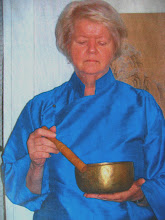
She smoothed a clean sheet on the massage table and invited me to lie down. “Let me show you how the bell works,” she said. She held the bell at the top of my head and rotated it so that the clapper circled around its inner rim. The clapper moved sluggishly, and the bell’s tone was dull. Its tone became clear, and the clapper moved briskly when she moved the bell slowly over my face, neck and chest.The bell reached my stomach. Again, it gave off a dull tone, and the clapper slowed. My secret was a severe headache and an upset stomach (1,2).
I sat up. “Please step down,” she commanded. “I want to demonstrate something that will surprise you.”
She moved the bell over the area where my body had been. The bell replicated the identical pattern of sound that it had produced when she had rung it over me. “You hear? Your sound imprint will linger for 4-5 minutes. Then it will fade away. The bell tells me,” she said, “that you have something wrong with your stomach and that you either suffer from mental illness or strong emotions about something or someone.” I let her guess.
She supplemented the tales of medical miracles that our host already had regaled us with. “La Hacienda is fast becoming famous for fabulous cures. Consider the girl born with one leg shorter than the other. After a few months of treatment, both legs are equal! Medical authorities have no explanation.”
She invited us to return for a healing. She quoted weekly rates and guaranteed that our stay would be as comfortable as if we were at a luxurious spa on the Pacific Coast. “We will think about it,” I assured her as we climbed into the car's broiling interior.
We had not gone far, when we looked out the back window and saw a cloud of dust. We rolled up the windows and pulled to the side to watch a car speed by spraying small stones and dirt. Inside were the massage therapist, the two “poor patients”, the blue-eyed, fair-skinned gardener and the man from Mexico City. We waited until their car vanished.
We looked at each other in astonishment. “Where are they rushing?” I asked.
“I don’t know,” Octavio responded. “Why do you suppose they are traveling all together?”
 We crossed more churches off our list as we circled the area around la Hacienda: the church of San Pedro Martir in Santa Lucia with faces of smiling angels tucked under the lintel of its entrance; the elaborate bamboo towers stored in a darkened shed awaiting the addition of rockets and firecrackers for Santa Lucia’s annual fiesta; San Felipe Apostol with Santa Cecelia and her harp; San Jacinto’s Gothic interior and Gothic altar; and Santa Ana with a tipsy right tower and aerial artists who were perched on scaffolding high in the nave, painting elegant decorations on the church’s white plaster walls and ceilings.
(1) Mosier, Helen. Hark! These Herald Angels Ring. The Bell Tower Supplement. Nov-Dec 1997 p. 16.
(2) Michaud, Debbie. The Healing Traditions and Spiritual Practices of Wicca. Keats Publishing, Los Angeles. 2000. pp. 48-49.
Friday, January 4, 2008
Scarlet
Octavio arrived at 9:30 a.m. He always pretended that he could meet me on the hour; however, it was difficult given the fact that he drove five children to different schools and a wife to work. Out of respect for his responsibilities as a husband and a father, I always asked him to arrive on the half hour. He never disappointed me.
 Our goal was the church in Santa Catarina Ixtepeji, a small town tucked into a valley. We had noticed it on our trips to Ixtlan. From the main road to Ixtlan, the church appeared large and commanding. It was a starred item on our list of sights to investigate.
We passed through three familiar towns. El Estudiante, la Cumbre and el Punto were placed like beads along the road. Each bead signified something special to us, and we welcomed each one with fond memories.
El Estudiante appealed to us as a place to retire. We often spoke about stopping and selecting two plots of land. They would have to be situated well away from the houses that were under construction, and they would have to have an unobstructed view of the mountains.
We didn't need a signpost to tell us when we reached the highest point of the route, la Cumbre (the summit). All we had to do was to feel the coolness. Octavio would slow the car, and we would take deep breaths of the fresh air through the open window.
The third bead was el Punto. Just before el Punto was a restaurant, el Monte, one of our favorites. That bead occasioned reminiscences of delicious food accompanied by a breathtaking view.
 We reached the turnoff to Santa Catarina Ixtepeji. It was marked by thick clumps of tall gladioli, their scarlet blooms radiant and luminous in the sun. Scarlet would be the keynote of the day.
A group of men and women waited at the turnoff. “Ixtepeji?” asked one of the men. “Are you going there?” Our rule of the road was no rides to strangers. That day was no exception.
Even though we felt sorry for the group standing in the harsh sun, Octavio called out, “Not yet,” and drove away to a second turnoff.
The dirt road was rough and bumpy. A sea of tall corn spread out on either side as far as we could see. In the distance, a solitary white egret had been cut from a Japanese scroll and glued against the horizon. The sun highlighted its yellow bill. Occasionally its head would dart forward and disappear; food was its agenda.
As the car jounced ever closer to town, the sandy-colored church loomed to our right. We heard rockets burst and saw flashes of light followed by plumes of gray-white smoke. A bend in the road and a garden of meticulously clipped topiary figures greeted us. A green waterfall of vines cascaded down the front of a neighboring house. The face of an adjacent cottage was hidden by a thick tangle of blue morning glories. A favorable first impression.
We entered town. The date was November 25, 1998. Santa Catarina Ixtepeji was beginning its celebration of the fiesta of St. Catherine of Alexandria. We were unexpected guests on the first of three days of festivities in her honor.
The car bounced up a steep stone-paved hill to the back of the church. Men and women were erecting booths for games, food and trinkets. In the church's shadow, women, selling a variety of fruits, sat on the ground leaning against one of the walls. Men and boys lounged around the church's entrance. On the side that faced away from town, mothers nursed babies while toddlers played at their feet.
We circled the 16th century church, el Templo de Santa Catarina, admiring its impressive construction. High up, square windows were recessed deep into the sides. The embrasures were whitewashed, and the openings around the embrasures were outlined with whitewash. Twin squat towers and a massive cupola, arising from an equally massive lantern placed above the center of the transept, added to the church's weighty appearance.
Across from the entrance was a stepped pyramid with a flat top. Several men already were seated on the steps, and we joined them. The platform was perfect for launching the fireworks that were being offered to St. Catherine. On one of the steps was a long bamboo pole, rockets and St. Catherine wheels. Without any detectable timetable, one of the men would get up, attach a rocket to the pole, climb to the platform and hurl the rocket into the air. It exploded with a terrific bang. Everyone, including us, enjoyed the noise.
The steps also were an ideal place from which to view the magnificent façade of the church. Masterful carving had gone into embellishing this imposing, house of worship. Every detail was a witness to the skill of the sculptors who had worked the stone.
Four elegant Solomonic columns ranged across the lower front of the façade, two on each side of the main door. Four more were paired on either side of an upper window. A series of niches progressed up the façade between the lower and upper sets of columns. Once, each niche had held a carved statue. Now, only a few remained. A triangle of graceful scrolls filled in the space on either side of the entrance’s arch between the arch's curve and the molding outlining the door. Above ran a frieze of medallion-like scrolls, their ends curving inwards to create fruit or foliage.
Colorful strands of pierced, multi-colored triangular banners emerged from the open window above the door, their ends fastened to stakes at a distance from the church. A strand of alternating red and white pierced banners stretched horizontally in front of the church.
 A rope of twisted evergreens and a rope of red and white linked chains with red and white bows were draped from the sides of a large crown of flowers hanging from the door's arch. The crown was made of red and white carnations; its ribs were gold flowers. A white vase filled with scarlet and white carnations and green feathery leaves swung from the opening at the bottom of the crown.
We left our seats, descended the steps and entered the church. A mass dedicated to St. Catherine was in progress. A brass band was playing. The band members were positioned just inside the entrance, their instruments gleaming in the dim light.
Our eyes adjusted to the dark, vast interior. We bypassed the people who stood or knelt on the floor at the back of the nave. The front pews were crammed with women, their heads covered with black mantillas. Behind them, benches were packed with men, women and children. A group of women made room for me, and I squeezed onto the end of the bench trying not to disturb the children playing on the floor. Octavio stood at my left.
And then it hit me. The scarlet. Scarlet is the color of martyrs. Scarlet is the color of St. Catherine. Man and Nature had joined together to provide a profusion of scarlet in order to commemorate this 4th century martyr. Wherever I looked there was scarlet. It blazed in the darkness.
The scarlet chasuble of the priest, the ankle-length scarlet dress of the statue of St. Catherine that stood at the front of the chancel, the scarlet banner trimmed with gold suspended to the right of the altar, the two fan-shaped arrangements of scarlet flowers atop long poles behind the altar on either side of the retablo. Fans of scarlet gladioli set the altar and transepts alight.
Baskets of scarlet and white carnations were suspended from the ceiling throughout the church. Decorative chains of evergreens and white streamers festooned the upper reaches of the nave and the chancel. We were in a celestial greenhouse. “St. Catherine must not care that she is no longer officially recognized,” I whispered to Octavio. “Surely it must not matter to her when such love is lavished on her.”
It was abundantly clear that St. Catherine was a survivor. She had been sentenced to be broken on a wheel and when the attempt was unsuccessful, to be beheaded (1). She was very much alive, though, in Ixtepiji in spite of the fact that her feast day had been removed from the Church calendar in 19691. In Ixtepeji, she was the adored center of attention in both the spiritual and earthly realms. The Church was offering up a mass and music. Nature was contributing scarlet flowers, and the people were donating joyful praise, special foods, fireworks and entertainment. Everyone had been waiting for her fiesta since last November.
The Hallelujah began. As the music from the choir and the brass band resonated throughout the church, we tiptoed out.
Families were continuing to make their way to the service. Their steps were solemn and measured; everyone wore an air of expectation. Later it would turn to rejoicing. Even the youngsters had abdicated their games in order to respect the seriousness of the occasion.
We stopped to inspect the backyard of a small house where a woman was preparing food in bright blue, green and yellow buckets and plastic bowls. Cooking odors drifted to us from pans atop braziers filled with hot coals. The smells made us hungry; it was well past noon. “Chicken mole,” the woman cried as she beckoned to us. Deciding that we wanted goat mole, we regretfully waved our thanks.
Pigs, lucky to be spared from being roasted for the feast, roamed in front yards without a care in the world. Not so, one trussed pig. He dangled by his feet from a tree while he waited to be cooked into delicious morsels to feed the hungry who later would crowd the food stalls.
We arrived at the plaza in front of the municipal offices. From there, we had a clear view of the surrounding mountains, which were densely carpeted with masses of orange flowers and fields of corn.

I was spellbound by the setting. Beautifully crafted adobe houses with steeply slanting tile roofs were terraced up the sides of the mountains. Sparkling white laundry flapped on clotheslines. Masses of tall scarlet poinsettias bloomed beside the houses. Lines of colorful triangular banners fluttered over the town.
 A man, sitting on the ground beside his donkeys, showed us a dirt road that headed in the direction of San Miguel del Rio. The road appeared safe. The sky was overcast with dark clouds. Orange flowers swept up the forested flanks of the mountains. Towering cacti were stationed like fierce sentinels on the slopes. Scarlet flowers with curving petals accented the sides of the road.
We expected an uneventful drive. Soon, however, we revised our opinion. We discovered that the road curved high above a gorge. Far below on the right was a river, a silver strand embedded deep within the landscape. We fervently prayed that no cars would travel that narrow, treacherous road, because its width and its placement between cliffs to the left and the yawning gorge to the right left no room to pull over if another vehicle approached. St. Catherine must have heard our prayers; we had the road to ourselves, both going and returning.
 The church in San Miguel del Rio was old, but much smaller and less powerful than the one in Ixtepeji. It was white with a pink dome atop each of its twin towers. It had a plain and simple front with a deep-set round window over its entrance door. The ends of multiple strings of yellow, pink, white and pale blue banners were secured in the window.
As in many churches outside of the City, one or two small rugs were scattered just inside the door. Most are worn and tattered, but that does not deter worshipers from conscientiously using them to scrape and clean their bare feet or shoes.
Two tall statues were against the right wall in the nave. They reminded me of two sleepwalkers. One had on a long-sleeved white gown; the other, a pale blue gown open at the neck with white ruffles around the edges of her long sleeves and the sides of the neck opening. Real hair streamed down their back. Their eyes stared at a distant point in space. Their arms and hands were outstretched as if they were straining to touch whatever they saw in the distance.
A nacimiento (Nativity) had been set up near an antique wooden Virgin whose earrings ended in dangling gold balls. White cotton fabric had been shaped to form a cave. Miniature red and white Christmas decorations and a band of silver tinsel were stretched across the cave's mouth. Mary and Joseph rested at the back, awaiting the Christ Child who would arrive at midnight on Christmas Eve.
Mary was decked out with jewelry. A tiny white heart surrounded by a larger red heart was pinned to the front of her gown. She wore two necklaces, one of white balls and one of red balls. Joseph’s head was covered with a sombrero, and he carried a hollow gourd for water, a natural thermos called a boule. A green, white and red ribbon, the colors of Mexico, diagonally crossed his chest.
Adjacent to the church were a municipal storage building, formerly a chapel, and a basketball court. A lively game was in progress. One of the spectators tore himself away and came toward us.
It is always worthwhile to talk with the people whenever one visits a town or a village. They like to know the purpose of a stranger’s visit, especially when there are no major tourist attractions. Not only does introducing oneself satisfy their curiosity, but it provides them with an opportunity to exchange news and gossip. In return for being open and honest, one gains their confidence and frequently learns important local information.
In this case, our self-appointed guide told us that there was a stand of tule trees about a fifteen minute walk from where we were, a walk, he assured us, that would be cool and pleasant, well out of the sun that had reappeared and was beating down on us. There was a small park under the tules. It was a popular picnic spot for families from San Miguel and from surrounding municipalities.
“We must see the tule trees,” we said to the man as he circled us around the basketball court and led us down a road away from the village. He was warm-hearted and amiable like most of the people we meet who are ever ready to drop whatever they are doing in order to talk with us or to show us around. “It is a pleasure,” they assure us.
As we leisurely strolled down the road with our man from San Miguel, a line of turkeys suddenly materialized at the top of a bank. In unison, the males began their ritual courtship, a slow, stately and repetitive dance in which they postured and spread their tail feathers into fans to entice the watching females. Suddenly the males refolded their tails and noiselessly disappeared over the bank, followed by the females.
The seven tule trees lived up to their reputation. They were the same species as the giant tule (also called Mexican cypress or huehuete) that is the attraction at Santa Maria del Tule, some eight miles beyond the City. That famous tule tree is reputed to be over 2,000 years old (2). The mammoth tules in San Miguel seemed almost as old as Santa Maria’s. They had thick soaring trunks with colossal branches crowned with enormous heads of green leaves. They grew in a semicircle.
Flights of steps, broken by landings, descended to the park's concrete floor. We lounged on freshly painted white wrought iron benches and enjoyed the gentle breezes. The only sound was the snap of the colorful banners strung overhead when an especially strong breeze danced through them.
Back in the village center, we thanked our guide. Leaving San Miguel, we returned to Ixtepeji and eventually rejoined the paved main road. From there, we looked across the valley in the direction of San Miguel to see if we could spot the tule trees. We found them, but how small they were! We never would have suspected they were tules.
We pulled into the restaurant, el Rio. It was built with one side and an end open to the air. We washed our hands at the outside faucet, dried them on a rough towel and sank into chairs to decide what to order.
But first a mezcal. Mine was served in the smallest of glasses deemed suitable for a woman. A consultation followed with the proprietress as to the menu of the day. By the time we finished the mezcal, chicken consommé filled with pieces of chicken, stew size cuts of carrots and potatoes, and white rice was in front of us on the table. We dipped into bowls of chopped cilantro and minced onion and stirred heaping spoonfuls of the condiments into the soup.
We ordered a second mezcal while we waited for the entrees. When the food arrived, it was everything we had hoped for. The ribs with rice was for Octavio; the chicken mole with rice for me. The meal ended with café de olla made by simmering cinnamon, sugar and coffee in an earthenware pot and then straining it into brown pottery bowls.
The proprietress convinced us to buy a cigarette to smoke with our coffee. She stepped to the counter that separated the kitchen from the eating area and selected two cigarettes from the pack that she reserved for customers. It was the only occasion during my travels in Oaxaca when I was offered a cigarette.
The car begged to have its dust washed off. Octavio, armed with a pail and cloths donated by the proprietress, attended to that chore. Afterwards, we explored the dirt road by the restaurant. The proprietress had recommended it, promising us an unparalleled view at the end.
The road made several sharp turns before it abruptly ended in a hamlet perched on a plateau. Several houses with outbuildings occupied land at each side of the plateau. They were tightly shut against the encroaching night. Hearing our voices, a child opened a door and peered out. I apologized for intruding, and she closed the door, leaving us alone with the sky and the mountains.
Not only was the proprietress a superb cook, but she had a profound sense of beauty. The plateau, jutting out over a valley, formed a stage ready-made for us to walk on center and play the role of speechless observers. It was almost dark; stars were becoming visible in the sky; flecks of light dotted the mountains. It was a private and intimate spot, so peaceful and quiet that we thought we could hear the earth turn.
We needed that interlude to clear our heads after the mezcal. And just to make sure that we were fit for the drive back to the City, we stopped again at el Rio to sip a final bowl of hot, strong aromatic coffee.
(1) http://www.catholic-forum.com/saints/saintc01.htm.
(2) Tule tree: Whipperman, Bruce. Oaxacan Handbook. Moon Travel Handbooks. Avalon Travel Publishing. Emeryville, CA. 2000. pp. 154-155.
 Our goal was the church in Santa Catarina Ixtepeji, a small town tucked into a valley. We had noticed it on our trips to Ixtlan. From the main road to Ixtlan, the church appeared large and commanding. It was a starred item on our list of sights to investigate.
We passed through three familiar towns. El Estudiante, la Cumbre and el Punto were placed like beads along the road. Each bead signified something special to us, and we welcomed each one with fond memories.
El Estudiante appealed to us as a place to retire. We often spoke about stopping and selecting two plots of land. They would have to be situated well away from the houses that were under construction, and they would have to have an unobstructed view of the mountains.
We didn't need a signpost to tell us when we reached the highest point of the route, la Cumbre (the summit). All we had to do was to feel the coolness. Octavio would slow the car, and we would take deep breaths of the fresh air through the open window.
The third bead was el Punto. Just before el Punto was a restaurant, el Monte, one of our favorites. That bead occasioned reminiscences of delicious food accompanied by a breathtaking view.
 We reached the turnoff to Santa Catarina Ixtepeji. It was marked by thick clumps of tall gladioli, their scarlet blooms radiant and luminous in the sun. Scarlet would be the keynote of the day.
A group of men and women waited at the turnoff. “Ixtepeji?” asked one of the men. “Are you going there?” Our rule of the road was no rides to strangers. That day was no exception.
Even though we felt sorry for the group standing in the harsh sun, Octavio called out, “Not yet,” and drove away to a second turnoff.
The dirt road was rough and bumpy. A sea of tall corn spread out on either side as far as we could see. In the distance, a solitary white egret had been cut from a Japanese scroll and glued against the horizon. The sun highlighted its yellow bill. Occasionally its head would dart forward and disappear; food was its agenda.
As the car jounced ever closer to town, the sandy-colored church loomed to our right. We heard rockets burst and saw flashes of light followed by plumes of gray-white smoke. A bend in the road and a garden of meticulously clipped topiary figures greeted us. A green waterfall of vines cascaded down the front of a neighboring house.
 The face of an adjacent cottage was hidden by a thick tangle of blue morning glories. A favorable first impression.
We entered town. The date was November 25, 1998. Santa Catarina Ixtepeji was beginning its celebration of the fiesta of St. Catherine of Alexandria. We were unexpected guests on the first of three days of festivities in her honor.
The car bounced up a steep stone-paved hill to the back of the church. Men and women were erecting booths for games, food and trinkets. In the church's shadow, women, selling a variety of fruits, sat on the ground leaning against one of the walls. Men and boys lounged around the church's entrance. On the side that faced away from town, mothers nursed babies while toddlers played at their feet.
We circled the 16th century church, el Templo de Santa Catarina, admiring its impressive construction. High up, square windows were recessed deep into the sides. The embrasures were whitewashed, and the openings around the embrasures were outlined with whitewash. Twin squat towers and a massive cupola, arising from an equally massive lantern placed above the center of the transept, added to the church's weighty appearance.
Across from the entrance was a stepped pyramid with a flat top. Several men already were seated on the steps, and we joined them. The platform was perfect for launching the fireworks that were being offered to St. Catherine. On one of the steps was a long bamboo pole, rockets and St. Catherine wheels. Without any detectable timetable, one of the men would get up, attach a rocket to the pole, climb to the platform and hurl the rocket into the air. It exploded with a terrific bang. Everyone, including us, enjoyed the noise.
The steps also were an ideal place from which to view the magnificent façade of the church. Masterful carving had gone into embellishing this imposing, house of worship. Every detail was a witness to the skill of the sculptors who had worked the stone.
Four elegant Solomonic columns ranged across the lower front of the façade, two on each side of the main door. Four more were paired on either side of an upper window. A series of niches progressed up the façade between the lower and upper sets of columns. Once, each niche had held a carved statue. Now, only a few remained. A triangle of graceful scrolls filled in the space on either side of the entrance’s arch between the arch's curve and the molding outlining the door. Above ran a frieze of medallion-like scrolls, their ends curving inwards to create fruit or foliage.
Colorful strands of pierced, multi-colored triangular banners emerged from the open window above the door, their ends fastened to stakes at a distance from the church. A strand of alternating red and white pierced banners stretched horizontally in front of the church.
 A rope of twisted evergreens and a rope of red and white linked chains with red and white bows were draped from the sides of a large crown of flowers hanging from the door's arch. The crown was made of red and white carnations; its ribs were gold flowers. A white vase filled with scarlet and white carnations and green feathery leaves swung from the opening at the bottom of the crown.
We left our seats, descended the steps and entered the church. A mass dedicated to St. Catherine was in progress. A brass band was playing. The band members were positioned just inside the entrance, their instruments gleaming in the dim light.
Our eyes adjusted to the dark, vast interior. We bypassed the people who stood or knelt on the floor at the back of the nave. The front pews were crammed with women, their heads covered with black mantillas. Behind them, benches were packed with men, women and children. A group of women made room for me, and I squeezed onto the end of the bench trying not to disturb the children playing on the floor. Octavio stood at my left.
And then it hit me. The scarlet. Scarlet is the color of martyrs. Scarlet is the color of St. Catherine. Man and Nature had joined together to provide a profusion of scarlet in order to commemorate this 4th century martyr. Wherever I looked there was scarlet. It blazed in the darkness.
The scarlet chasuble of the priest, the ankle-length scarlet dress of the statue of St. Catherine that stood at the front of the chancel, the scarlet banner trimmed with gold suspended to the right of the altar, the two fan-shaped arrangements of scarlet flowers atop long poles behind the altar on either side of the retablo. Fans of scarlet gladioli set the altar and transepts alight.
Baskets of scarlet and white carnations were suspended from the ceiling throughout the church. Decorative chains of evergreens and white streamers festooned the upper reaches of the nave and the chancel. We were in a celestial greenhouse. “St. Catherine must not care that she is no longer officially recognized,” I whispered to Octavio. “Surely it must not matter to her when such love is lavished on her.”
It was abundantly clear that St. Catherine was a survivor. She had been sentenced to be broken on a wheel and when the attempt was unsuccessful, to be beheaded (1). She was very much alive, though, in Ixtepiji in spite of the fact that her feast day had been removed from the Church calendar in 19691. In Ixtepeji, she was the adored center of attention in both the spiritual and earthly realms. The Church was offering up a mass and music. Nature was contributing scarlet flowers, and the people were donating joyful praise, special foods, fireworks and entertainment. Everyone had been waiting for her fiesta since last November.
The Hallelujah began. As the music from the choir and the brass band resonated throughout the church, we tiptoed out.
Families were continuing to make their way to the service. Their steps were solemn and measured; everyone wore an air of expectation. Later it would turn to rejoicing. Even the youngsters had abdicated their games in order to respect the seriousness of the occasion.
We stopped to inspect the backyard of a small house where a woman was preparing food in bright blue, green and yellow buckets and plastic bowls. Cooking odors drifted to us from pans atop braziers filled with hot coals. The smells made us hungry; it was well past noon. “Chicken mole,” the woman cried as she beckoned to us. Deciding that we wanted goat mole, we regretfully waved our thanks.
Pigs, lucky to be spared from being roasted for the feast, roamed in front yards without a care in the world. Not so, one trussed pig. He dangled by his feet from a tree while he waited to be cooked into delicious morsels to feed the hungry who later would crowd the food stalls.
We arrived at the plaza in front of the municipal offices. From there, we had a clear view of the surrounding mountains, which were densely carpeted with masses of orange flowers and fields of corn.

I was spellbound by the setting. Beautifully crafted adobe houses with steeply slanting tile roofs were terraced up the sides of the mountains. Sparkling white laundry flapped on clotheslines. Masses of tall scarlet poinsettias bloomed beside the houses. Lines of colorful triangular banners fluttered over the town.
 A man, sitting on the ground beside his donkeys, showed us a dirt road that headed in the direction of San Miguel del Rio. The road appeared safe. The sky was overcast with dark clouds. Orange flowers swept up the forested flanks of the mountains. Towering cacti were stationed like fierce sentinels on the slopes. Scarlet flowers with curving petals accented the sides of the road.
We expected an uneventful drive. Soon, however, we revised our opinion. We discovered that the road curved high above a gorge. Far below on the right was a river, a silver strand embedded deep within the landscape. We fervently prayed that no cars would travel that narrow, treacherous road, because its width and its placement between cliffs to the left and the yawning gorge to the right left no room to pull over if another vehicle approached. St. Catherine must have heard our prayers; we had the road to ourselves, both going and returning.
 The church in San Miguel del Rio was old, but much smaller and less powerful than the one in Ixtepeji. It was white with a pink dome atop each of its twin towers. It had a plain and simple front with a deep-set round window over its entrance door. The ends of multiple strings of yellow, pink, white and pale blue banners were secured in the window.
As in many churches outside of the City, one or two small rugs were scattered just inside the door. Most are worn and tattered, but that does not deter worshipers from conscientiously using them to scrape and clean their bare feet or shoes.
Two tall statues were against the right wall in the nave. They reminded me of two sleepwalkers. One had on a long-sleeved white gown; the other, a pale blue gown open at the neck with white ruffles around the edges of her long sleeves and the sides of the neck opening. Real hair streamed down their back. Their eyes stared at a distant point in space. Their arms and hands were outstretched as if they were straining to touch whatever they saw in the distance.
A nacimiento (Nativity) had been set up near an antique wooden Virgin whose earrings ended in dangling gold balls. White cotton fabric had been shaped to form a cave. Miniature red and white Christmas decorations and a band of silver tinsel were stretched across the cave's mouth. Mary and Joseph rested at the back, awaiting the Christ Child who would arrive at midnight on Christmas Eve.
Mary was decked out with jewelry. A tiny white heart surrounded by a larger red heart was pinned to the front of her gown. She wore two necklaces, one of white balls and one of red balls. Joseph’s head was covered with a sombrero, and he carried a hollow gourd for water, a natural thermos called a boule. A green, white and red ribbon, the colors of Mexico, diagonally crossed his chest.
Adjacent to the church were a municipal storage building, formerly a chapel, and a basketball court. A lively game was in progress. One of the spectators tore himself away and came toward us.
It is always worthwhile to talk with the people whenever one visits a town or a village. They like to know the purpose of a stranger’s visit, especially when there are no major tourist attractions. Not only does introducing oneself satisfy their curiosity, but it provides them with an opportunity to exchange news and gossip. In return for being open and honest, one gains their confidence and frequently learns important local information.
In this case, our self-appointed guide told us that there was a stand of tule trees about a fifteen minute walk from where we were, a walk, he assured us, that would be cool and pleasant, well out of the sun that had reappeared and was beating down on us. There was a small park under the tules. It was a popular picnic spot for families from San Miguel and from surrounding municipalities.
“We must see the tule trees,” we said to the man as he circled us around the basketball court and led us down a road away from the village. He was warm-hearted and amiable like most of the people we meet who are ever ready to drop whatever they are doing in order to talk with us or to show us around. “It is a pleasure,” they assure us.
As we leisurely strolled down the road with our man from San Miguel, a line of turkeys suddenly materialized at the top of a bank. In unison, the males began their ritual courtship, a slow, stately and repetitive dance in which they postured and spread their tail feathers into fans to entice the watching females. Suddenly the males refolded their tails and noiselessly disappeared over the bank, followed by the females.
The seven tule trees lived up to their reputation. They were the same species as the giant tule (also called Mexican cypress or huehuete) that is the attraction at Santa Maria del Tule, some eight miles beyond the City. That famous tule tree is reputed to be over 2,000 years old (2). The mammoth tules in San Miguel seemed almost as old as Santa Maria’s. They had thick soaring trunks with colossal branches crowned with enormous heads of green leaves. They grew in a semicircle.
Flights of steps, broken by landings, descended to the park's concrete floor. We lounged on freshly painted white wrought iron benches and enjoyed the gentle breezes. The only sound was the snap of the colorful banners strung overhead when an especially strong breeze danced through them.
Back in the village center, we thanked our guide. Leaving San Miguel, we returned to Ixtepeji and eventually rejoined the paved main road. From there, we looked across the valley in the direction of San Miguel to see if we could spot the tule trees. We found them, but how small they were! We never would have suspected they were tules.
We pulled into the restaurant, el Rio. It was built with one side and an end open to the air. We washed our hands at the outside faucet, dried them on a rough towel and sank into chairs to decide what to order.
But first a mezcal. Mine was served in the smallest of glasses deemed suitable for a woman. A consultation followed with the proprietress as to the menu of the day. By the time we finished the mezcal, chicken consommé filled with pieces of chicken, stew size cuts of carrots and potatoes, and white rice was in front of us on the table. We dipped into bowls of chopped cilantro and minced onion and stirred heaping spoonfuls of the condiments into the soup.
We ordered a second mezcal while we waited for the entrees. When the food arrived, it was everything we had hoped for. The ribs with rice was for Octavio; the chicken mole with rice for me. The meal ended with café de olla made by simmering cinnamon, sugar and coffee in an earthenware pot and then straining it into brown pottery bowls.
The proprietress convinced us to buy a cigarette to smoke with our coffee. She stepped to the counter that separated the kitchen from the eating area and selected two cigarettes from the pack that she reserved for customers. It was the only occasion during my travels in Oaxaca when I was offered a cigarette.
The car begged to have its dust washed off. Octavio, armed with a pail and cloths donated by the proprietress, attended to that chore. Afterwards, we explored the dirt road by the restaurant. The proprietress had recommended it, promising us an unparalleled view at the end.
The road made several sharp turns before it abruptly ended in a hamlet perched on a plateau. Several houses with outbuildings occupied land at each side of the plateau. They were tightly shut against the encroaching night. Hearing our voices, a child opened a door and peered out. I apologized for intruding, and she closed the door, leaving us alone with the sky and the mountains.
Not only was the proprietress a superb cook, but she had a profound sense of beauty. The plateau, jutting out over a valley, formed a stage ready-made for us to walk on center and play the role of speechless observers. It was almost dark; stars were becoming visible in the sky; flecks of light dotted the mountains. It was a private and intimate spot, so peaceful and quiet that we thought we could hear the earth turn.
We needed that interlude to clear our heads after the mezcal. And just to make sure that we were fit for the drive back to the City, we stopped again at el Rio to sip a final bowl of hot, strong aromatic coffee.
(1) http://www.catholic-forum.com/saints/saintc01.htm.
(2) Tule tree: Whipperman, Bruce. Oaxacan Handbook. Moon Travel Handbooks. Avalon Travel Publishing. Emeryville, CA. 2000. pp. 154-155.
Ixtlan de Juarez Part II
A billboard on the outskirts of the village advertised that Calpulalpan was home to a center that distributed indigenous plants from the Sierra Juarez. A man waiting by the sign directed us to the Centro de Desarrollo de Medicina Indigena Tradicional.
We entered the waiting room to find two diminutive curanderas (curanderas are women healers; curanderos are either men healers or men and women healers) seated in small chairs, talking to a tall woman who introduced herself as the clinic's President. We requested a consultation and a limpia (a cleaning) by a curandera. The President escorted us into a sparsely furnished room. A trestle table and small chair were at the back of the room. A tin container filled with fresh green herbs was on the table. To the left was a window. Two small chairs were near the door.
One of the curanderas who had been in the waiting room when we arrived, entered and took a seat at the table facing us. Octavio offered to be first. He drew close to her and described his symptoms. She instructed him to place one of the chairs at a right angle to me and to the table. She left the room and reappeared with a long sheaf of fresh herbs in one hand and an unbroken egg in the other. She spread the sheaf of herbs and placed the egg in its center, enclosed the egg with the herbs and sprinkled them with a clear liquid.
She stepped up to Octavio with the herbs in her right hand. Lowering them to within several inches of his body, she began to brush him. She proceeded to brush his front and back, all the while praying in a low monotone. She made the sign of the cross with them over the front of his body and turned toward the table.
She extracted the egg from the herbs and broke it into a glass that she had filled with clear liquid from a bottle. She held the glass with the unbroken egg yolk in it up to the window. Speaking inaudible mantras and prayers, she slowly rotated the glass in the sunlight. We watched as the egg white clumped around the yolk. She carried the glass to Octavio and explained what the pattern of the egg white revealed about his condition. She prescribed an ointment, nose drops and the application of green leaves to his neck for two consecutive nights.
She left the room and came back holding a clear bottle of liquid in one hand and an amber glass bottle of liquid in the other. Octavio whispered, “Is it my imagination or do I detect the faint smell of mezcal?” She mixed the two liquids in one of the bottles and took a mouthful from the bottle.
Standing far back, she waited in silence. Without warning, a mist of fine spray erupted from her mouth and hit him in the face. She went to stand in front of him and began spraying mouthfuls of the liquid onto the back and front of his head, chest, palms and knees, all the while brushing him with the herbs. Abruptly she stopped and threw the herbs in a corner on the floor.
It was my turn. She went to get a fresh bunch of herbs and another egg. My cleaning duplicated Octavio’s. The pungent smell of herbs filled the room. I felt peaceful and calm. Having watched the procedure, I knew what to expect. Her low voice, murmuring prayers and chants, relaxed me.
Only a tiny white spot formed on the side of my egg yolk. When she brought the glass to me, she softly asked, “Triste? Do you feel triste?” Of course, I felt sad. I always felt sad at leaving Oaxaca. It had become a nostalgia lodged deep within me. It was good news, though, that except for sadness, I was in good health. A sigh of relief swept through me.
I thought I was prepared for the next step. I watched her take a mouthful of liquid, watched her stand at a distance, and I waited, and I waited. I was confident that when she sprayed me I would be in total control. The sudden force of the liquid hit my face, and at that moment my entire system went into shock. That was it for poise and control. My rational, logical side went into hiding.
Close to me, she repeatedly took sips of the liquid and sprayed it outside and inside the neck of my T-shirt. She sprayed the left and right sides of my shirt. After each spraying, she patted the fabric to my skin. She proceeded to spray my back, both sides of my hands and the back and front of both knees.
A woman appeared in the open door and began making notes. “I'm in training,” she announced as she requested our names, ages and origins and recorded them in a large ledger. “Would you like to tour the Center?” she asked. We nodded, and the President joined us.
We learned that the Center had been in operation for some six to eight years and offered general consultations and services for pregnant women, childbirth and newborns. The staff included curanderos, chiropractors and herbalists from surrounding villages.
The sun-drenched courtyard had clotheslines sagging with freshly washed laundry and bedding. Arranged around the courtyard were sparsely furnished bedrooms with one or two mattresses on the floor, bathrooms with shining white porcelain toilets, which didn’t flush, the temazcal and a recuperation room.
The temazcal was too small for my height. I would have had to curl into a ball to fit inside its domed shape. The President explained that special herbs are placed on stones outside the temazcal. A curandera pours boiling water over the herbs and stones in order to create steam that flows through an opening into the interior chamber. The amount of boiling water regulates the quantity of steam and the temperature inside the chamber. This ancient purification and healing system for cleansing the body and the soul dates from pre-Hispanic days. It is especially beneficial after childbirth, because it tightens a woman's stomach and abdomen. Patients usually spend several hours in the temazcal, followed by an hour in the recuperation room.
The President ushered us into the pharmacy where tiers of shelves held packages and boxes of remedies and immaculately clean jars and containers of herbal pharmaceuticals. The herbs were collected in the early morning from nearby mountains. They were then made into ointments, soaps, teas and salves in Capulalpan before being brought to the Center.
Back in Ixtlan, we deliberated about where to eat, finally selecting a restaurant near the market. First was a glass of mezcal. I was an eager pupil as Octavio taught me to sprinkle salt on the back of my hand and lick the salt after each sip. “There is a saying,” he said, “that mezcal makes one's food muy sabroso (more tasty).”
We lunched on cream of squash soup and meat in yellow mole accompanied by string beans, potato wedges and rice. The ever-present basket of hot tortillas sat on the table between us. “Look,” I exclaimed after uncovering them. “The top one has a face on it. I’m saving that one for you.”
Octavio sighed. “You are becoming Mexican. You are seeing shapes in the tortillas, the clouds and the trees just as we do.”
It was too early to return to the City. Octavio inquired about adjacent towns. We decided to go beyond Ixtlan and visit Santa Maria Jaltianguis. Its church was locked. We peeked through cracks in the carved panels of its arched wooden door. Darkness and dust were all we saw.
Jaltianguis had to be the hottest place on earth. The sun beat down relentlessly. There was no shade. I found a wall overhung with jacaranda blooms and slouched against it, contracting my body into the smallest possible area while Octavio went to search for whoever might have the key to the church. He came back empty-handed. “The people are suspicious. It’s best to leave.” Even I could feel the suspicion. It clouded the air. The village was blanketed in a wary silence.
Before we departed, we took one last look at the ancient stone face attached to the church's left front wall. Centuries ago, an unknown artist had carved rudimentary round eyes, a nose and full lips in the stone. Now the face stared back at us.
We drove as far as el Estudiante in order to eat before we attempted the last leg of the route to the City. While we ate, Octavio spoke about local customs. “In many small villages and rural hamlets the people serve at mass, because priests are scarce, and a resident priest is costly. Parishioners will invite a priest to officiate at a special ceremony, such as a marriage or a baptism. Marriage costs money : the clothes, the music the priest, the sacrificing of a goat. That is why when we tell a friend about a problem, we add, ‘That’s why I’m not married’”
A full stomach helped Octavio cope with the remainder of the drive. Having ascended a steep grade and rounded a curve, we came face to face with burros in the middle of the road. There was nothing to do but stop and wait until they moved. They took their time. Descending, we met an oncoming truck. Octavio signaled the driver to be on the lookout for trouble. Burros in the road on a blind curve would be an unwelcome hazard.
That was my initiation into signals that warn motorists of impending danger. Drivers of trailer trucks blink the lights on the outside of their trucks' cabin; other motorists use headlights. Hands are signals too. A sign language. Hands convey swift and clearly visible warnings with an economy and fluidity of movement that may mean the difference between life and a cross planted at the side of a road.
We encountered two slow-moving trucks hauling enormous logs on low bed trailers. Passing was a problem. Their length and the ever-present curves made it impossible to see in front of them. The drivers helped. They motioned to us when the road ahead was clear, reduced their speed to a crawl and pulled over to the right as far as possible. In response, Octavio, alert for the sudden appearance of an oncoming vehicle, cautiously inched up beside them, then spurted ahead. The drivers flashed their lights; we waved and disappeared around the next curve.
(1) Zapotec: one of the 16 indigenous groups in the State of Oaxaca, each with its own language. The Zapotecs are the largest group.
(2) Oropendola: Peterson, Roger Tory and Chalif, Edward L. A Field Guide to Mexican Birds. Houghton Mifflin Co., NY. Plate 39.
(3) There are red, yellow, black and green moles. The sauces are made from a variety of chilies, spices and herbs and are used with pork or chicken. During special festivities, mole is used with turkey. Oaxaca is called Land of the Seven Moles, and Susana Trilling in her book, Seasons of My Heart (Ballentine Books, N.Y., 1999) describes the seven moles in Chapter 10.
Ixtlan de Juarez
We made three trips to Ixtlan de Juarez and surrounding towns. The first was during the rainy season, the second and third during the dry season. Each trip showered us with special gifts. At the end, I felt as if the area were my second home, a home with pine and oak forests and ever-changing clouds, which continually played light and shadow over the landscape.
September 3, 1996 introduced me to the route to Ixtlan. It was a steady climb in altitude through lush vegetation. Ahead, a metal bridge spanned a rushing river. We turned off and parked on a dirt road that followed the river's course. The water was in full force, speeding over the stones in the riverbed and winking in the sun. Patches of foam, scattered across the top of the water, mirrored puffs of white clouds clumped in the blue sky.
Hibiscus trees, rampant morning glories and tiny black-eyed Susans shielded blocks of slate along the river’s edge. Swallowtail butterflies sailed by, and yellow, orange and spotted butterflies flitted over the clay bank. A few lazily fanned their wings while they rested on the ground. They did not fly away when we bent over them. Either they had just emerged from cocoons and were drying their wings or sensed that we meant them no harm.
We arrived in San Pedro Guelatao, the birthplace of Benito Juarez and parked near the impressive arcaded plaza built in his memory. He was born nearby in 1906 to Zapotec parents who died when he was three, leaving him to live with an uncle(1). The plaza overlooked the small town. Downhill were silos with conical roofs for storing corn. Clustered nearby were small houses. Bean vines curling around tall poles, plots of corn, laundry hanging on clotheslines and turkeys roaming in back yards presented a scene of quiet domesticity.
 One length of the plaza was devoted to a museum of Juarez’s life. It was closed on Mondays, but a placard on the wall detailed in Spanish his achievements. The opposite length afforded unobstructed views of the Sierra Juarez. Distant peaks were slate blue; those in the middle distance dark green; those closest to us bright green. Anyone who complained of monotony would be richly rewarded by spending time in the company of these mountains.
We found a spring-fed pond bordered by scarlet flowering trees. Dragonflies skimmed over the water’s surface. “Caballitos del Diablo,” Octavio said, “little horses of the Devil, that’s the children’s name for them. And look at that one.” A small red damselfly zipped by.
A bronze statue of Juarez stood beside the water. The sculptor had cast him as a young boy accompanied by the sheep that he had herded for his uncle. Later, at the age of 12, he would walk from Guelatao to the City to join his sister, a route that eventually enabled him to be Governor of Oaxaca and to be elected three times the President of Mexico.
We went part way around the pond and then followed a trail that branched off the path. “Ah, here is a school. Let me find out if we can tour the grounds.” Octavio disappeared inside one of the buildings. He emerged, pleased. He had interrupted a teacher in a classroom, and the teacher had given us permission to be on the property.
We looked in the windows of a dormitory. Rows of beds with natural wooden frames were covered with off-white spreads woven with wide red and blue stripes. Students, who came from too far away to return home at the end of the day, slept there. Their commuting time was measured in hours or days of walking.
Close by was a small hut. Inside, two women were making tortillas for the students’ lunch. As we ducked our heads to enter, we met a blast of unmerciful heat from the fires and the lack of ventilation. The women’s faces were flushed and shiny with perspiration. They beamed a welcome.
Each woman had her own equipment, and each had produced a tall stack of tortillas. “Watch,” one of the women said. “We put the masa on this flat piece.” She placed the dough on an iron griddle. “Now I put some of this on top,” and she placed a piece of plastic on top of the masa. “Now look,” she said as she pulled down the top of the griddle and pressed it on the masa. “I've made a tortilla." She transferred the tortilla to a charcoal brazier and left it for the right amount of time. No clocks or timers for these cooks. Instinct and years of experience guided them.
It was the other woman’s turn to take the spotlight. She removed two tortillas from the top of her stack and handed one to each of us. “Please take salt.” she invited. “It brings out the flavor of the tortillas.” We pinched salt crystals between our fingers and sprinkled them over the tortillas. We rolled them and took a bite. Our smiles conveyed how good they tasted. The women smiled in response.
“This is the way mountain people eat tortillas,” Octavio said. The woman nodded in agreement.
Black beans, onions and garlic simmered in a deep iron pot atop a brazier outside the kitchen. The aroma was tantalizing. I was positive the cooks wouldn't offer us any. The only utensil in sight was a ladle in the stew. Furthermore, there only was enough to feed the students. It would be easier to replace two tortillas than to explain why there were not enough beans. Thanks to these two women the students ate well and heartily. “Yes,” one of them volunteered, “my work is hard. I like it. I like it, but it is very hot here.”
“We make good food for the children,” added the other.
We asked directions to Ixtlan de Juarez, located about two miles north of Guelatao. Juarez had been baptized in Ixtlan's parish church, the Templo de Santo Tomas Apostol. Its construction had begun around 1640, and its date of completion 1721 was inscribed on an arch inside the main door. “A canyon arch,” Octavio explained, “like an upside down canyon.”
The main and side facades were different. The main facade was in the Churrigueresque style, a style of the late Baroque characterized by florid carving, estipite columns and Salomonic pillars (named after the columns on the Temple of Solomon). There were three double tiers of Salomonic pillars on either side of the main entrance. This type of column appears twisted.
 The direction of the coils on each of the pairs happened to be the mirror image of its companion column. In more extravagant examples, the pillars may spiral with intricate foliate designs.
The side façade was a gem. Grapes, shells and plant-life were the predominant motifs. Over the door was a bas-relief of the Virgin standing on scalloped clouds. Raised outlines of a square cross enclosed the carving. Two Salomonic columns framed each side of the entablature. Above, God ruled from the apex of the high curve at the top of the façade.
The current church had been built on a pronounced rise. An overgrowth of trees and shrubs covered stonework and rocks. Octavio hypothesized that the site might conceal a former temple. “It was part of the Dominicans’ plan,” he said, “to choose land sacred to the Zapotecs, destroy their temples and replace them with Catholic churches.”
The interior was intimate. Immediately upon entering, our attention was captured by the retablo behind the altar. Lavish, gilded carving covered its soaring main panel and the two side panels that angled out from it. The gleam of the gold and the riot of intricate designs luxuriating over its surface appeared to assume a life of their own. God presided over all that sumptuousness at the top of the main screen.
As we stood before the main altar, Octavio introduced me to estipite columns, another characteristic of the Churrigueresque style. The retablo columns were estipite, inverted pyramids with their tip cut off and placed on a block. Sometimes the pattern of an inverted pyramid is clearly repeated up the column. Other times the elements of the column are so richly carved that the shape of the pyramid recedes into the background.
Opulent gilded retablos from the eighteenth century, decorated with Salomonic pillars and oil paintings of saints and religious scenes, flanked the nave. Angels with dark hair and nontraditional faces suggested the influence of local workmanship.
A Trinity was attached to a wall in the nave. El Padre Eterno wore His triple crown and was seated on His throne. His hands held a crucified Jesus, but the Holy Spirit, represented by a dove on top of the crucifix, had broken off.
I was intrigued by a painting of three men with triangular haloes who surrounded a woman. Octavio identified the subject, the Trinity crowning the Virgin. I commented on how rare triangular halos were. “Oh, no," Octavio responded. “In Oaxaca they are very common. You will have to look for them. They are everywhere.”
Octavio selected del Monte for our late afternoon meal. The restaurant, situated between la Cumbre and el Punto, was on several levels. Inside, a flight of stairs descended to the dining room where a wall of windows gave diners a panoramic view of the landscape. Silvery lichens dusted a weathered split rail fence at the bottom of a slope across from the windows. Scarlet gladioli and white calla lilies grew in front of the fence. A bleached animal skull rested against a post. It was pure Georgia O'Keefe. It was a scene, I felt sure, that she would have loved to paint.
The arrival of the entrees interrupted our contemplation of the scenery: a large tortilla topped with avocado, lettuce, tomato and cheese and a slice of meat accompanied by cucumber and tomato slices. No need to discuss dessert. We both knew fried plantains were our favorite. The waiter set the dessert plates in front of us. Five slices of fried plantain, arranged like flower petals, enclosed a center of strawberry preserves topped with a dollop of whipped cream.
A thunderstorm moved across the mountaintops. Lightening crackled through the sky. We tracked the storm. It intensified as it approached so that sheets of rain sealed us off from the outside world. We waited. Driving would have been reckless. The sky began to clear. On cue, the waiter brought steaming coffee. It was his way of apologizing for our delayed departure.
April 21, 1997 marked our second trip to Ixtlan. After we were in the mountains, we noticed a large black bird, possibly a raven. We watched it through the windshield flying in a straight, sure line. The flapping of its large wings conveyed purpose. Suddenly a smaller bird flew in at an angle and overtook it. It buzzed it like a toy airplane before pacing its flight to the larger bird’s.
I guessed what we would see before it happened: something I had read about but never witnessed. I waited without speaking or moving, afraid that I might disturb the plan that was being worked out. The two birds concluded their negotiations, and the smaller bird glided onto the back of the larger one. They continued out of sight, the larger bird neither deviating from its path nor slowing its speed.
I nudged Octavio. “Did you see that?”
“Yes,” he replied. “I’ve been watching.”
“I’ve read about birds giving rides to birds.”
“I have too.”
“What if we hadn’t been here at this very moment? Do you realize that we would have missed this?”
“Yes”, he agreed, “we have seen a great thing.”
 Thick bushes of floripondia covered with long white trumpet flowers lined the road from Guelatao to Ixtlan. “Coquitos,” Octavio announced as he motioned to leafless trees that sported red flowers bursting from the ends of bare branches. Blossoming hibiscus and jacaranda trees and bougainvillea vines added vibrant color. Green and yellow-streaked gourds dried in the sun on the flat roofs of wood sheds.
We arrived in Ixtlan greeting it as an old friend but hoping to discover new qualities and dimensions in that friend. Octavio went to ask the police if he had chosen an approved parking spot. He returned relieved that we could leave the car in the space he had selected at the side of the dirt street next to the market.
A church, dated August 1721, called for closer inspection. Years ago an earthquake had demolished its walls and interior. Only an arch, incised with a simple, repetitive design, remained upright. A burrow, tethered to one of the stone blocks that littered the ground, waited for its owner.
The market abutted the ruins. It was a Monday, the weekly market day for Ixtlan. Arriving near noon, we missed the early morning shoppers; however, enough fruit and vegetables remained to give us an idea of what was in season.
I needed a bathroom. Where was the woman who supervised the public toilets? There she was, right in the corner near the entrance. Her rate of exchange was three pesos for the key to the damas and a few sheets of toilet paper. There was more to come. “Un momento.” She advised me to enter the door marked caballeros. “Hombres go in the door without a sign.”
The heavy padlock on the caballeros was rusted. I wondered how long it had remained unopened. Octavio struggled with the padlock until his determination and his strong arm prevailed. I entered with trepidation, unsure of the standard of cleanliness I would find. My fears, however, were groundless. I confronted two spotlessly clean toilets. Neither flushed, but each had a red plastic pail on its tank. Later, the toilet guardian would fill one of the pails at a faucet in the market and use it to flush the toilet.
I emerged from the caballeros to find a man waiting to enter. Octavio was trying to explain that it was not the caballeros but the damas. It took all of Octavio’s patience to make the man understand that the key he held in his hand opened the padlock on the door without a sign, the door to the caballeros.
A shrine and flower stalls were at the opposite end of the market. We liked the waxy yellow orchids that looked like dwarf tulips. The orchids could be cultivated as long as they were watered regularly. Octavio bought twenty plants for his garden and five for me. When the flower vendor learned we were from the City, she covered the plants with sheets of newspaper to protect them from the sun. We rushed to the car where we placed them on the back floor. During the remainder of the day, their perfume scented the car. And during my stay in the City, they added a delicate fragrance to my room.
We paid a repeat visit to the church where Juarez had been baptized. A different attendant was on duty. He had an eagle eye. When he spotted me positioning my camera, he halted the action. He refused to let me take a picture. Octavio asked him to read the sign on the church door: photographs were permitted within the church as long as no flash was used. A quiet but intense discussion ensued between the two men. Octavio asked him to explain the discrepancy between what the sign said and what he was telling us. The attendant was adamant. I thought he wanted a bribe, but Octavio disagreed. “He just has a different understanding of the rule."
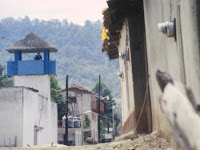 We walked toward the mountains along a dirt road. We passed a prison. It was white-washed and windowless, and on its flat roof was an open-sided tower with a blue base and a conical top to shade the guard on duty. Octavio knew nothing about prisons, but I was curious. “Who were the prisoners, how many were there, what crimes had they committed, what did they eat?” Questions raced through my mind as I continued to look back at the building with its lone sentry.
We stopped near the end of the road. The strong sun forced us to shield our eyes. Octavio let out a muted cry. “There at the top of the mountain. What is it? It’s tiny, and it isn’t moving, so it can’t be a man. It must be a statue.”
“It must be a statue of someone important,” I hypothesized. “As a rule, ordinary citizens don't get monuments on mountains.”
“Yes,” people said in response to our query, “there is a statue and a mirador. Go to the end of the road at the other end of town and take the rough road. Your car can make it. Go slowly.”
We drove up through stands of deciduous and fir trees. The car groaned and pitched in potholes until we arrived at the top where a covering of palm fronds provided shelter for a car. At the edge of the clearing, two mammoth figures looked out over the valley. They represented the two Zapotec warriors who had been responsible for defeating the invading Aztecs.
We headed into the woods. Two men carrying machetes silently glided through the forest. Notices tacked to trees advised that cutting wood was prohibited. I asked Octavio if they planned to cut wood illegally, but he reminded me that the woods were communal land and that the men would operate within strict forestry guidelines.
Long empty bags, fashioned from tightly woven plant fibers, hung from tree branches. Which birds had constructed them? The owner of del Monte, where we later ate, supplied the answer; they were nests of the oropendola(2).
From Ixtlan, we continued to Capulalpan in order to visit its parish church. We paid the obligatory visit to the town hall to ask if someone could open the church door. The clerk at the desk explained that a man rang the church bells at 3 p.m. when he was not working in the outlying fields. We waited, but the bell ringer didn’t appear. Disappointed, we retraced our route through Ixtlan and Guelatao until we could stop at del Monte for a much needed meal.
Octavio had two beers, cream of corn soup and ribs. I had a guava drink, cream of corn soup and chicken mole served with pureed black beans(3). We shared a basket of corn crisps with our soup and a basket of hot tortillas wrapped in a cloth. Our favorite dessert, fried plantains, followed. Coffee with cinnamon, made in a clay pot called an olla, completed the dinner.
Our third trip was on April 17, 1998. High overhead, vultures drifted and soared in updrafts. Octavio stopped the car to show me a fruit tree called zapote. There are white, yellow and black zapotes. The white zapote acts as a soporific; eating three puts one to sleep. In addition, a tincture of the white zapote aids in lowering high blood pressure.
Trees were posted with warnings not to light fires. The lack of a rainy season had resulted in combustible woods. Many fires still burned. Octavio’s garden had suffered too. The drought had claimed three fruit trees and the orchids he had bought last year in Ixtlan. In contrast to the dry woods and patched fields, Capulalpan appeared to be an oasis. Tall bushes were festooned with masses of pale pink trumpet flowers, their edges ruffled in a deeper pink.
Just as last year, our first stop was at the municipal office. Perhaps this year we would learn who had a key to the church. I waited outside. I wanted to read the notice about dengue fever. Local authorities take great care to educate their citizens not only about diseases such as tuberculosis, measles and dengue fever but also about health precautions. The walls of a town’s municipal building or its medical clinic, or a sheet tied to a fence on the outskirts of a village serve as medical bulletin boards.
Workmen were restoring the exterior of the church. They might have a key. In fact, they were the key to our success, because they directed us to Senor S. who lived down the street, a short walk from the church. He was at home. At his doorstep I received a lesson in Oaxacan diplomacy. Senor S., rightfully concerned about who we were and why we sought access to the church, engaged Octavio in a prolonged series of questions and answers without revealing that he had the coveted key. Senor S., finally convinced that we meant no harm, produced the key and led us to the church.
Although it may seem curious that we should have difficulty gaining entrance to a church in a village, there was an important reason why we had to undergo such relentless scrutiny. A valuable statue had been stolen from a church in a neighboring town. And there had been attempted break-ins in nearby churches; consequently, anyone entrusted with a church key was reluctant to acknowledge that he possessed it. Prudence was the order of the day. Local repercussions might ensue if a custodian carelessly unlocked a parish church to strangers who might steal from or damage that church. Having a church key is a responsibility that no one treats lightly.
The church was completed and dedicated to Saint Matthew in 1718; however, the year 1731 appeared on an arch inside the door. The arch and the ceiling above it had been restored to their original condition of brightly painted designs of vines, tendrils and flowers.
The transept ceiling had been renovated in 1954. Carpenters had replaced the rotting wood of the ceiling with wood treated against insects. The ceiling looked like the inside of a boat’s skeleton. Row after row of small squares of wood were set end to end across its width. Each row alternated with a narrow raised rib of wood.
A tall angel carved from wood with glass eyes guarded each side of the steps leading up to the sanctuary. A large silver lamp hung over the steps. Two crystal chandeliers were suspended in the sanctuary in front of the altar. Behind the altar, a five-sided, gilded retablo soared to the ceiling in gleaming splendor.
Several of the gilded retablos along the nave walls were of finely carved wood and embellished with exquisitely carved angels and estipite columns. In the right transept was a retablo with a statue of St. Joseph. He wore a straw hat with an adjustable chin strap and held a miniature hollow gourd, called a bule or calabaza, which travelers carry water in.
We tipped Senor S. and went next door to a store. Its ceiling was a replica of the church’s. The woman behind the counter was proud that such an unusual and elegant feature graced her humble space. She made sure that we knew that her husband had helped with the restoration of the church’s interior and had copied its ceiling.
While we sipped beers and talked with the owner, I looked over her merchandise for something to buy. A pile of escobetas was on the counter. Short pieces of straw of equal length are bound together in the center with a wire to make a brush. Octavio reminisced how his mother cleaned the tops of tables and chests with her escobeta. Local shops and markets still sell them, although modern brushes and brooms are more popular in the City and large towns. I paid two pesos for a souvenir of another way of life. The shopkeeper was happy, because two pesos make a difference in the sum of a day's transactions. In addition, my purchase and our presence would provide ingredients for a good story to tell the family at the end of the day.
To be continued
September 3, 1996 introduced me to the route to Ixtlan. It was a steady climb in altitude through lush vegetation. Ahead, a metal bridge spanned a rushing river. We turned off and parked on a dirt road that followed the river's course. The water was in full force, speeding over the stones in the riverbed and winking in the sun. Patches of foam, scattered across the top of the water, mirrored puffs of white clouds clumped in the blue sky.
Hibiscus trees, rampant morning glories and tiny black-eyed Susans shielded blocks of slate along the river’s edge. Swallowtail butterflies sailed by, and yellow, orange and spotted butterflies flitted over the clay bank. A few lazily fanned their wings while they rested on the ground. They did not fly away when we bent over them. Either they had just emerged from cocoons and were drying their wings or sensed that we meant them no harm.
We arrived in San Pedro Guelatao, the birthplace of Benito Juarez and parked near the impressive arcaded plaza built in his memory. He was born nearby in 1906 to Zapotec parents who died when he was three, leaving him to live with an uncle(1). The plaza overlooked the small town. Downhill were silos with conical roofs for storing corn. Clustered nearby were small houses. Bean vines curling around tall poles, plots of corn, laundry hanging on clotheslines and turkeys roaming in back yards presented a scene of quiet domesticity.
 One length of the plaza was devoted to a museum of Juarez’s life. It was closed on Mondays, but a placard on the wall detailed in Spanish his achievements. The opposite length afforded unobstructed views of the Sierra Juarez. Distant peaks were slate blue; those in the middle distance dark green; those closest to us bright green. Anyone who complained of monotony would be richly rewarded by spending time in the company of these mountains.
We found a spring-fed pond bordered by scarlet flowering trees. Dragonflies skimmed over the water’s surface. “Caballitos del Diablo,” Octavio said, “little horses of the Devil, that’s the children’s name for them. And look at that one.” A small red damselfly zipped by.
A bronze statue of Juarez stood beside the water. The sculptor had cast him as a young boy accompanied by the sheep that he had herded for his uncle. Later, at the age of 12, he would walk from Guelatao to the City to join his sister, a route that eventually enabled him to be Governor of Oaxaca and to be elected three times the President of Mexico.
We went part way around the pond and then followed a trail that branched off the path. “Ah, here is a school. Let me find out if we can tour the grounds.” Octavio disappeared inside one of the buildings. He emerged, pleased. He had interrupted a teacher in a classroom, and the teacher had given us permission to be on the property.
We looked in the windows of a dormitory. Rows of beds with natural wooden frames were covered with off-white spreads woven with wide red and blue stripes. Students, who came from too far away to return home at the end of the day, slept there. Their commuting time was measured in hours or days of walking.
Close by was a small hut. Inside, two women were making tortillas for the students’ lunch. As we ducked our heads to enter, we met a blast of unmerciful heat from the fires and the lack of ventilation. The women’s faces were flushed and shiny with perspiration. They beamed a welcome.
Each woman had her own equipment, and each had produced a tall stack of tortillas. “Watch,” one of the women said. “We put the masa on this flat piece.” She placed the dough on an iron griddle. “Now I put some of this on top,” and she placed a piece of plastic on top of the masa. “Now look,” she said as she pulled down the top of the griddle and pressed it on the masa. “I've made a tortilla." She transferred the tortilla to a charcoal brazier and left it for the right amount of time. No clocks or timers for these cooks. Instinct and years of experience guided them.
It was the other woman’s turn to take the spotlight. She removed two tortillas from the top of her stack and handed one to each of us. “Please take salt.” she invited. “It brings out the flavor of the tortillas.” We pinched salt crystals between our fingers and sprinkled them over the tortillas. We rolled them and took a bite. Our smiles conveyed how good they tasted. The women smiled in response.
“This is the way mountain people eat tortillas,” Octavio said. The woman nodded in agreement.
Black beans, onions and garlic simmered in a deep iron pot atop a brazier outside the kitchen. The aroma was tantalizing. I was positive the cooks wouldn't offer us any. The only utensil in sight was a ladle in the stew. Furthermore, there only was enough to feed the students. It would be easier to replace two tortillas than to explain why there were not enough beans. Thanks to these two women the students ate well and heartily. “Yes,” one of them volunteered, “my work is hard. I like it. I like it, but it is very hot here.”
“We make good food for the children,” added the other.
We asked directions to Ixtlan de Juarez, located about two miles north of Guelatao. Juarez had been baptized in Ixtlan's parish church, the Templo de Santo Tomas Apostol. Its construction had begun around 1640, and its date of completion 1721 was inscribed on an arch inside the main door. “A canyon arch,” Octavio explained, “like an upside down canyon.”
The main and side facades were different. The main facade was in the Churrigueresque style, a style of the late Baroque characterized by florid carving, estipite columns and Salomonic pillars (named after the columns on the Temple of Solomon). There were three double tiers of Salomonic pillars on either side of the main entrance. This type of column appears twisted.
 The direction of the coils on each of the pairs happened to be the mirror image of its companion column. In more extravagant examples, the pillars may spiral with intricate foliate designs.
The side façade was a gem. Grapes, shells and plant-life were the predominant motifs. Over the door was a bas-relief of the Virgin standing on scalloped clouds. Raised outlines of a square cross enclosed the carving. Two Salomonic columns framed each side of the entablature. Above, God ruled from the apex of the high curve at the top of the façade.
The current church had been built on a pronounced rise. An overgrowth of trees and shrubs covered stonework and rocks. Octavio hypothesized that the site might conceal a former temple. “It was part of the Dominicans’ plan,” he said, “to choose land sacred to the Zapotecs, destroy their temples and replace them with Catholic churches.”
The interior was intimate. Immediately upon entering, our attention was captured by the retablo behind the altar. Lavish, gilded carving covered its soaring main panel and the two side panels that angled out from it. The gleam of the gold and the riot of intricate designs luxuriating over its surface appeared to assume a life of their own. God presided over all that sumptuousness at the top of the main screen.
As we stood before the main altar, Octavio introduced me to estipite columns, another characteristic of the Churrigueresque style. The retablo columns were estipite, inverted pyramids with their tip cut off and placed on a block. Sometimes the pattern of an inverted pyramid is clearly repeated up the column. Other times the elements of the column are so richly carved that the shape of the pyramid recedes into the background.
Opulent gilded retablos from the eighteenth century, decorated with Salomonic pillars and oil paintings of saints and religious scenes, flanked the nave. Angels with dark hair and nontraditional faces suggested the influence of local workmanship.
A Trinity was attached to a wall in the nave. El Padre Eterno wore His triple crown and was seated on His throne. His hands held a crucified Jesus, but the Holy Spirit, represented by a dove on top of the crucifix, had broken off.
I was intrigued by a painting of three men with triangular haloes who surrounded a woman. Octavio identified the subject, the Trinity crowning the Virgin. I commented on how rare triangular halos were. “Oh, no," Octavio responded. “In Oaxaca they are very common. You will have to look for them. They are everywhere.”
Octavio selected del Monte for our late afternoon meal. The restaurant, situated between la Cumbre and el Punto, was on several levels. Inside, a flight of stairs descended to the dining room where a wall of windows gave diners a panoramic view of the landscape. Silvery lichens dusted a weathered split rail fence at the bottom of a slope across from the windows. Scarlet gladioli and white calla lilies grew in front of the fence. A bleached animal skull rested against a post. It was pure Georgia O'Keefe. It was a scene, I felt sure, that she would have loved to paint.
The arrival of the entrees interrupted our contemplation of the scenery: a large tortilla topped with avocado, lettuce, tomato and cheese and a slice of meat accompanied by cucumber and tomato slices. No need to discuss dessert. We both knew fried plantains were our favorite. The waiter set the dessert plates in front of us. Five slices of fried plantain, arranged like flower petals, enclosed a center of strawberry preserves topped with a dollop of whipped cream.
A thunderstorm moved across the mountaintops. Lightening crackled through the sky. We tracked the storm. It intensified as it approached so that sheets of rain sealed us off from the outside world. We waited. Driving would have been reckless. The sky began to clear. On cue, the waiter brought steaming coffee. It was his way of apologizing for our delayed departure.
April 21, 1997 marked our second trip to Ixtlan. After we were in the mountains, we noticed a large black bird, possibly a raven. We watched it through the windshield flying in a straight, sure line. The flapping of its large wings conveyed purpose. Suddenly a smaller bird flew in at an angle and overtook it. It buzzed it like a toy airplane before pacing its flight to the larger bird’s.
I guessed what we would see before it happened: something I had read about but never witnessed. I waited without speaking or moving, afraid that I might disturb the plan that was being worked out. The two birds concluded their negotiations, and the smaller bird glided onto the back of the larger one. They continued out of sight, the larger bird neither deviating from its path nor slowing its speed.
I nudged Octavio. “Did you see that?”
“Yes,” he replied. “I’ve been watching.”
“I’ve read about birds giving rides to birds.”
“I have too.”
“What if we hadn’t been here at this very moment? Do you realize that we would have missed this?”
“Yes”, he agreed, “we have seen a great thing.”
 Thick bushes of floripondia covered with long white trumpet flowers lined the road from Guelatao to Ixtlan. “Coquitos,” Octavio announced as he motioned to leafless trees that sported red flowers bursting from the ends of bare branches. Blossoming hibiscus and jacaranda trees and bougainvillea vines added vibrant color. Green and yellow-streaked gourds dried in the sun on the flat roofs of wood sheds.
We arrived in Ixtlan greeting it as an old friend but hoping to discover new qualities and dimensions in that friend. Octavio went to ask the police if he had chosen an approved parking spot. He returned relieved that we could leave the car in the space he had selected at the side of the dirt street next to the market.
A church, dated August 1721, called for closer inspection. Years ago an earthquake had demolished its walls and interior. Only an arch, incised with a simple, repetitive design, remained upright. A burrow, tethered to one of the stone blocks that littered the ground, waited for its owner.
The market abutted the ruins. It was a Monday, the weekly market day for Ixtlan. Arriving near noon, we missed the early morning shoppers; however, enough fruit and vegetables remained to give us an idea of what was in season.
I needed a bathroom. Where was the woman who supervised the public toilets? There she was, right in the corner near the entrance. Her rate of exchange was three pesos for the key to the damas and a few sheets of toilet paper. There was more to come. “Un momento.” She advised me to enter the door marked caballeros. “Hombres go in the door without a sign.”
The heavy padlock on the caballeros was rusted. I wondered how long it had remained unopened. Octavio struggled with the padlock until his determination and his strong arm prevailed. I entered with trepidation, unsure of the standard of cleanliness I would find. My fears, however, were groundless. I confronted two spotlessly clean toilets. Neither flushed, but each had a red plastic pail on its tank. Later, the toilet guardian would fill one of the pails at a faucet in the market and use it to flush the toilet.
I emerged from the caballeros to find a man waiting to enter. Octavio was trying to explain that it was not the caballeros but the damas. It took all of Octavio’s patience to make the man understand that the key he held in his hand opened the padlock on the door without a sign, the door to the caballeros.
A shrine and flower stalls were at the opposite end of the market. We liked the waxy yellow orchids that looked like dwarf tulips. The orchids could be cultivated as long as they were watered regularly. Octavio bought twenty plants for his garden and five for me. When the flower vendor learned we were from the City, she covered the plants with sheets of newspaper to protect them from the sun. We rushed to the car where we placed them on the back floor. During the remainder of the day, their perfume scented the car. And during my stay in the City, they added a delicate fragrance to my room.
We paid a repeat visit to the church where Juarez had been baptized. A different attendant was on duty. He had an eagle eye. When he spotted me positioning my camera, he halted the action. He refused to let me take a picture. Octavio asked him to read the sign on the church door: photographs were permitted within the church as long as no flash was used. A quiet but intense discussion ensued between the two men. Octavio asked him to explain the discrepancy between what the sign said and what he was telling us. The attendant was adamant. I thought he wanted a bribe, but Octavio disagreed. “He just has a different understanding of the rule."
 We walked toward the mountains along a dirt road. We passed a prison. It was white-washed and windowless, and on its flat roof was an open-sided tower with a blue base and a conical top to shade the guard on duty. Octavio knew nothing about prisons, but I was curious. “Who were the prisoners, how many were there, what crimes had they committed, what did they eat?” Questions raced through my mind as I continued to look back at the building with its lone sentry.
We stopped near the end of the road. The strong sun forced us to shield our eyes. Octavio let out a muted cry. “There at the top of the mountain. What is it? It’s tiny, and it isn’t moving, so it can’t be a man. It must be a statue.”
“It must be a statue of someone important,” I hypothesized. “As a rule, ordinary citizens don't get monuments on mountains.”
“Yes,” people said in response to our query, “there is a statue and a mirador. Go to the end of the road at the other end of town and take the rough road. Your car can make it. Go slowly.”
We drove up through stands of deciduous and fir trees. The car groaned and pitched in potholes until we arrived at the top where a covering of palm fronds provided shelter for a car. At the edge of the clearing, two mammoth figures looked out over the valley. They represented the two Zapotec warriors who had been responsible for defeating the invading Aztecs.
We headed into the woods. Two men carrying machetes silently glided through the forest. Notices tacked to trees advised that cutting wood was prohibited. I asked Octavio if they planned to cut wood illegally, but he reminded me that the woods were communal land and that the men would operate within strict forestry guidelines.
Long empty bags, fashioned from tightly woven plant fibers, hung from tree branches. Which birds had constructed them? The owner of del Monte, where we later ate, supplied the answer; they were nests of the oropendola(2).
From Ixtlan, we continued to Capulalpan in order to visit its parish church. We paid the obligatory visit to the town hall to ask if someone could open the church door. The clerk at the desk explained that a man rang the church bells at 3 p.m. when he was not working in the outlying fields. We waited, but the bell ringer didn’t appear. Disappointed, we retraced our route through Ixtlan and Guelatao until we could stop at del Monte for a much needed meal.
Octavio had two beers, cream of corn soup and ribs. I had a guava drink, cream of corn soup and chicken mole served with pureed black beans(3). We shared a basket of corn crisps with our soup and a basket of hot tortillas wrapped in a cloth. Our favorite dessert, fried plantains, followed. Coffee with cinnamon, made in a clay pot called an olla, completed the dinner.
Our third trip was on April 17, 1998. High overhead, vultures drifted and soared in updrafts. Octavio stopped the car to show me a fruit tree called zapote. There are white, yellow and black zapotes. The white zapote acts as a soporific; eating three puts one to sleep. In addition, a tincture of the white zapote aids in lowering high blood pressure.
Trees were posted with warnings not to light fires. The lack of a rainy season had resulted in combustible woods. Many fires still burned. Octavio’s garden had suffered too. The drought had claimed three fruit trees and the orchids he had bought last year in Ixtlan. In contrast to the dry woods and patched fields, Capulalpan appeared to be an oasis. Tall bushes were festooned with masses of pale pink trumpet flowers, their edges ruffled in a deeper pink.
Just as last year, our first stop was at the municipal office. Perhaps this year we would learn who had a key to the church. I waited outside. I wanted to read the notice about dengue fever. Local authorities take great care to educate their citizens not only about diseases such as tuberculosis, measles and dengue fever but also about health precautions. The walls of a town’s municipal building or its medical clinic, or a sheet tied to a fence on the outskirts of a village serve as medical bulletin boards.
Workmen were restoring the exterior of the church. They might have a key. In fact, they were the key to our success, because they directed us to Senor S. who lived down the street, a short walk from the church. He was at home. At his doorstep I received a lesson in Oaxacan diplomacy. Senor S., rightfully concerned about who we were and why we sought access to the church, engaged Octavio in a prolonged series of questions and answers without revealing that he had the coveted key. Senor S., finally convinced that we meant no harm, produced the key and led us to the church.
Although it may seem curious that we should have difficulty gaining entrance to a church in a village, there was an important reason why we had to undergo such relentless scrutiny. A valuable statue had been stolen from a church in a neighboring town. And there had been attempted break-ins in nearby churches; consequently, anyone entrusted with a church key was reluctant to acknowledge that he possessed it. Prudence was the order of the day. Local repercussions might ensue if a custodian carelessly unlocked a parish church to strangers who might steal from or damage that church. Having a church key is a responsibility that no one treats lightly.
The church was completed and dedicated to Saint Matthew in 1718; however, the year 1731 appeared on an arch inside the door. The arch and the ceiling above it had been restored to their original condition of brightly painted designs of vines, tendrils and flowers.
The transept ceiling had been renovated in 1954. Carpenters had replaced the rotting wood of the ceiling with wood treated against insects. The ceiling looked like the inside of a boat’s skeleton. Row after row of small squares of wood were set end to end across its width. Each row alternated with a narrow raised rib of wood.
A tall angel carved from wood with glass eyes guarded each side of the steps leading up to the sanctuary. A large silver lamp hung over the steps. Two crystal chandeliers were suspended in the sanctuary in front of the altar. Behind the altar, a five-sided, gilded retablo soared to the ceiling in gleaming splendor.
Several of the gilded retablos along the nave walls were of finely carved wood and embellished with exquisitely carved angels and estipite columns. In the right transept was a retablo with a statue of St. Joseph. He wore a straw hat with an adjustable chin strap and held a miniature hollow gourd, called a bule or calabaza, which travelers carry water in.
We tipped Senor S. and went next door to a store. Its ceiling was a replica of the church’s. The woman behind the counter was proud that such an unusual and elegant feature graced her humble space. She made sure that we knew that her husband had helped with the restoration of the church’s interior and had copied its ceiling.
While we sipped beers and talked with the owner, I looked over her merchandise for something to buy. A pile of escobetas was on the counter. Short pieces of straw of equal length are bound together in the center with a wire to make a brush. Octavio reminisced how his mother cleaned the tops of tables and chests with her escobeta. Local shops and markets still sell them, although modern brushes and brooms are more popular in the City and large towns. I paid two pesos for a souvenir of another way of life. The shopkeeper was happy, because two pesos make a difference in the sum of a day's transactions. In addition, my purchase and our presence would provide ingredients for a good story to tell the family at the end of the day.
To be continued
Subscribe to:
Posts (Atom)